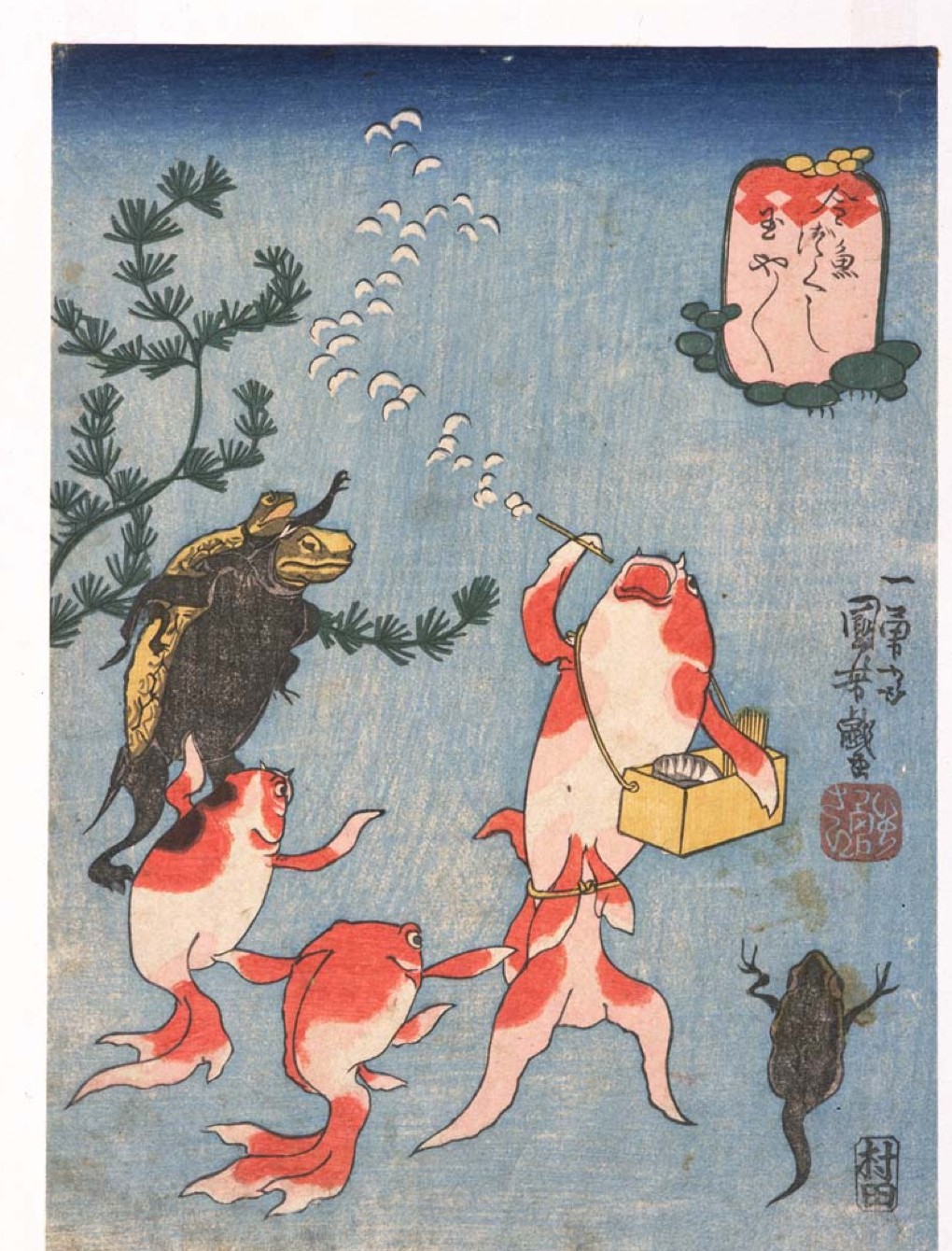
You already speak a little Japanese.
Manga. Emoji. Kitsune. There are Japanese words that sit inside English sentences untranslated, still carrying their own sound. If you follow anime or games, you are probably using more of them than you think.
Only the words made the crossing, though.
Take chibi. You know what it means — that deliberately squashed way of drawing a character, big head, small body. So what would you say if I told you those drawings already existed in Edo Japan? And that you could buy one, printed on a toy sheet, at a shop counter?
In this article I’ve taken eight Japanese words that live inside English, and set one woodblock print beside each of them. Prints made between roughly 130 and 200 years ago. This isn’t an etymology lesson. It’s simpler than that: whatever the word points to, someone in Edo had already drawn it.
One of the eight is in the name of this site, incidentally. The ukiyo in Floating World Journal — the same ukiyo as in ukiyo-e. (That word has a story of its own, but that’s for another day.)
Let’s start with the first one.
1. Manga
In Japanese, manga is two characters: man, meaning rambling, or following your whim, and ga, pictures. Pictures drawn as the hand pleases.
The person who made the word famous was Katsushika Hokusai. In 1814 he published Hokusai Manga, a set of sketchbooks meant as models for students. No story. No panels. People dancing, wrestlers grappling, travelers caught in the wind — everything he saw, gathered in one place, like a dictionary made of drawings. (The modern meaning, the comics you read, came much later.)
It’s what’s inside the book that surprises you.
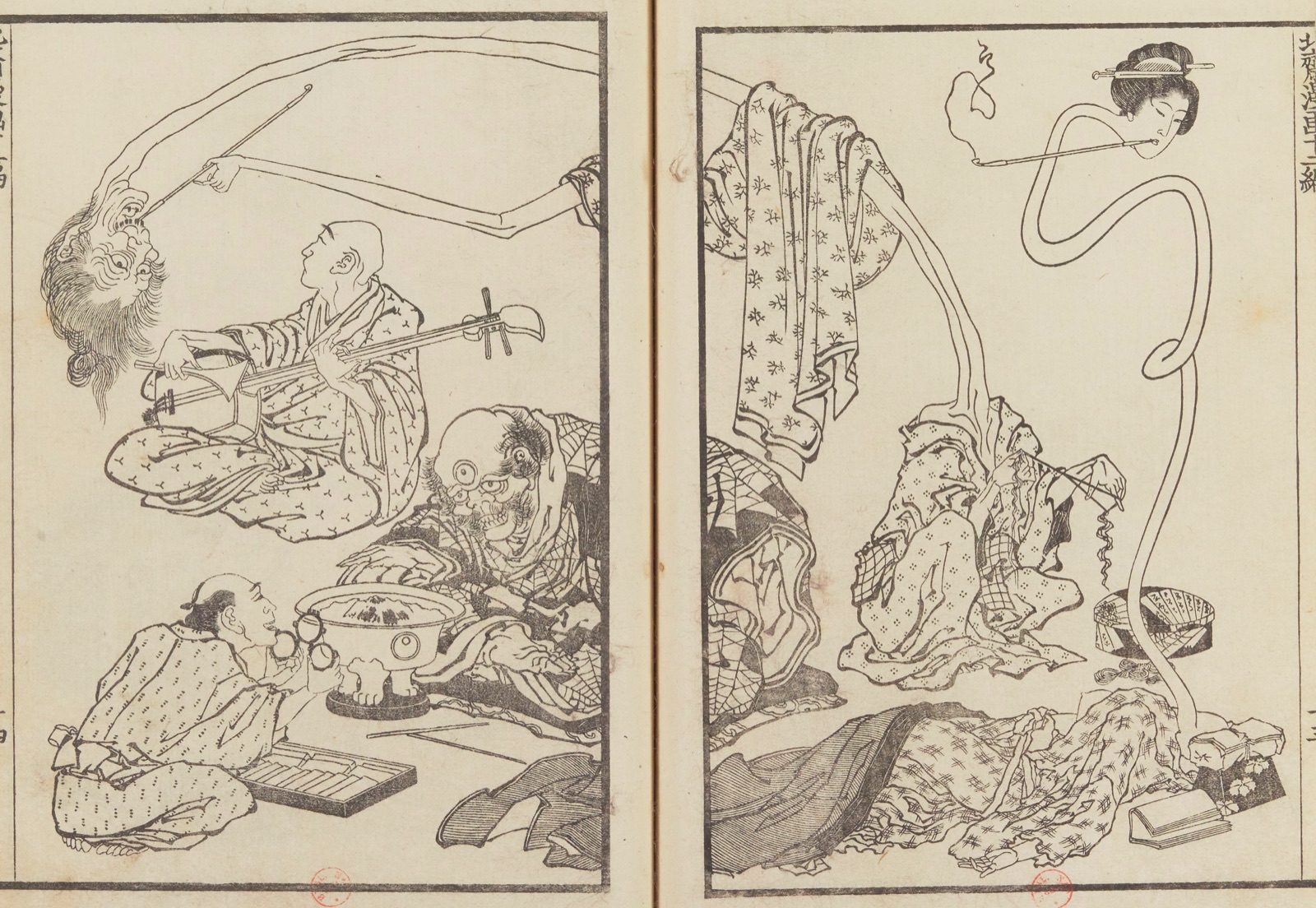
This spread seems to be an evening gathering. A man plays the shamisen, a sake vessel sits on the floor, a woman draws on a long pipe. Except that her neck rises all the way to the ceiling, a bearded severed head floats in the air, and from the right, a long thin arm comes reaching in.
A book of everyday sketches, with monsters sitting in it as though nothing were out of place. Hokusai drew them with the same hand he used for wind and wrestlers.
2. Chibi
Chibi means something small. Aimed at a person in Japanese it can land as an insult, though used for your own child or a pet it turns affectionate instead. By the time it reached English, that edge had worn off. Now it names a way of drawing: big head, small body, the deliberate squash.
This is a toy print — omocha-e, cheap woodblock sheets made for children — from 1862. The artist is Utagawa Yoshifuji, known in his own day as “Yoshifuji of the toy prints,” and a student of Utagawa Kuniyoshi.
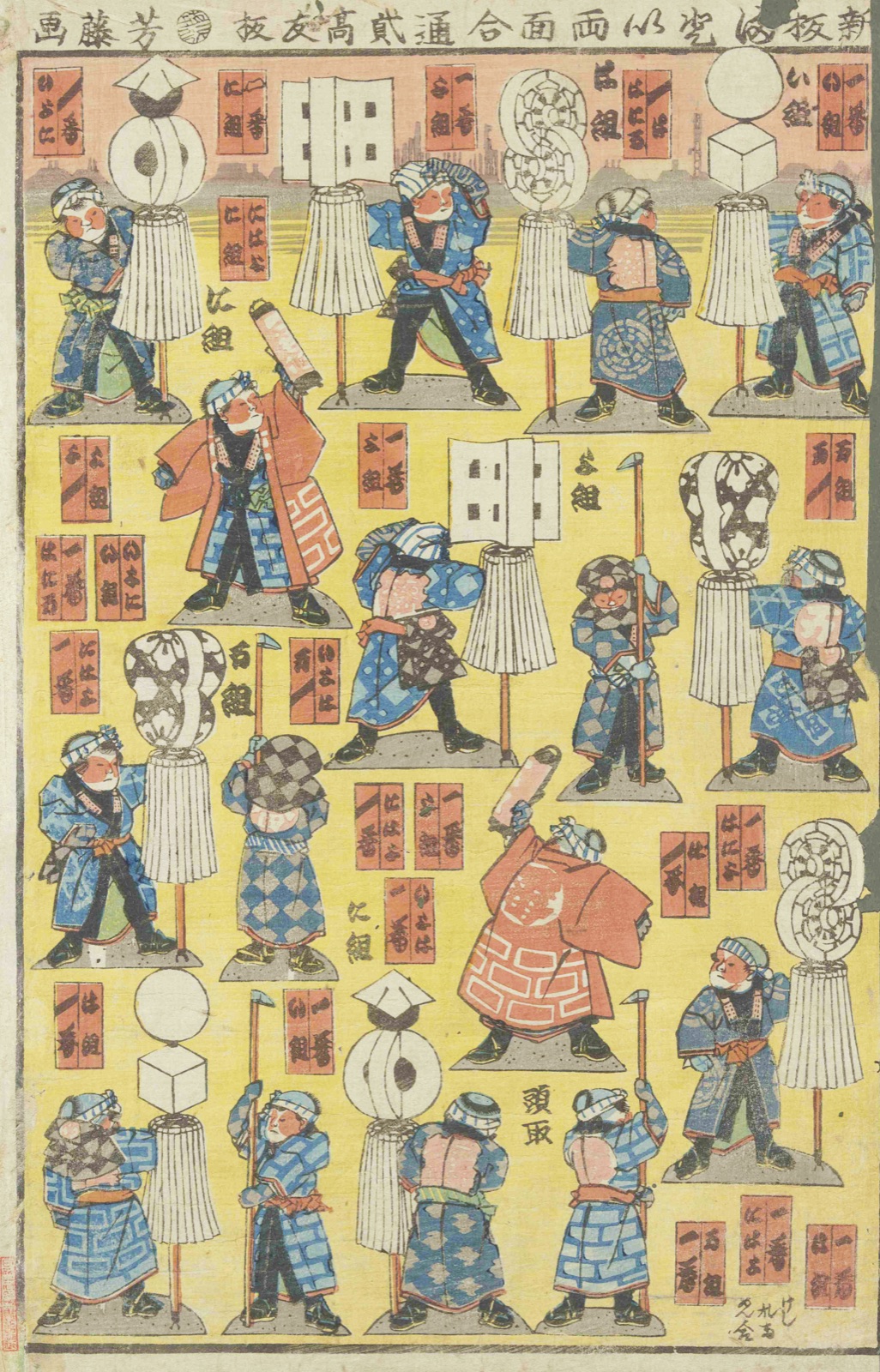
The figures are Edo firefighters. Firefighters were the heroes of the city then, and every brigade carried its own standard, a matoi, held up high so that everyone could see whose men had arrived. Here they fill the sheet, dozens of them, two heads tall.
And this is the part worth noticing: they are not small men. The artist is drawing them small. Take the heroes of the city, shrink them, make them cute, line them up in rows. It’s the same pleasure as scrolling through chibi versions of characters you love.
3. Emoji
This is one you may be using without knowing it’s Japanese.
Emoji is e, picture, plus moji, character. Picture-characters. It has nothing to do with emotion or emoticon — the resemblance is pure coincidence.
The interesting part is the names.
Unicode — the standard that lets every device in the world display the same character — never changes an official name once it has been assigned. So 👹 is registered, permanently, as JAPANESE OGRE, and 👺 as JAPANESE GOBLIN. Others sit there too: 🎎 is JAPANESE DOLLS, 🎏 is CARP STREAMER, 🍡 is DANGO.
And yet the name your phone reads out today is usually just “ogre.” Just “goblin.” The official name still says Japanese. The name on the surface has had it trimmed away.
👺, by the way, is drawn the same way by every vendor: red face, long nose. It’s a tengu mask.
That mask is in this print.
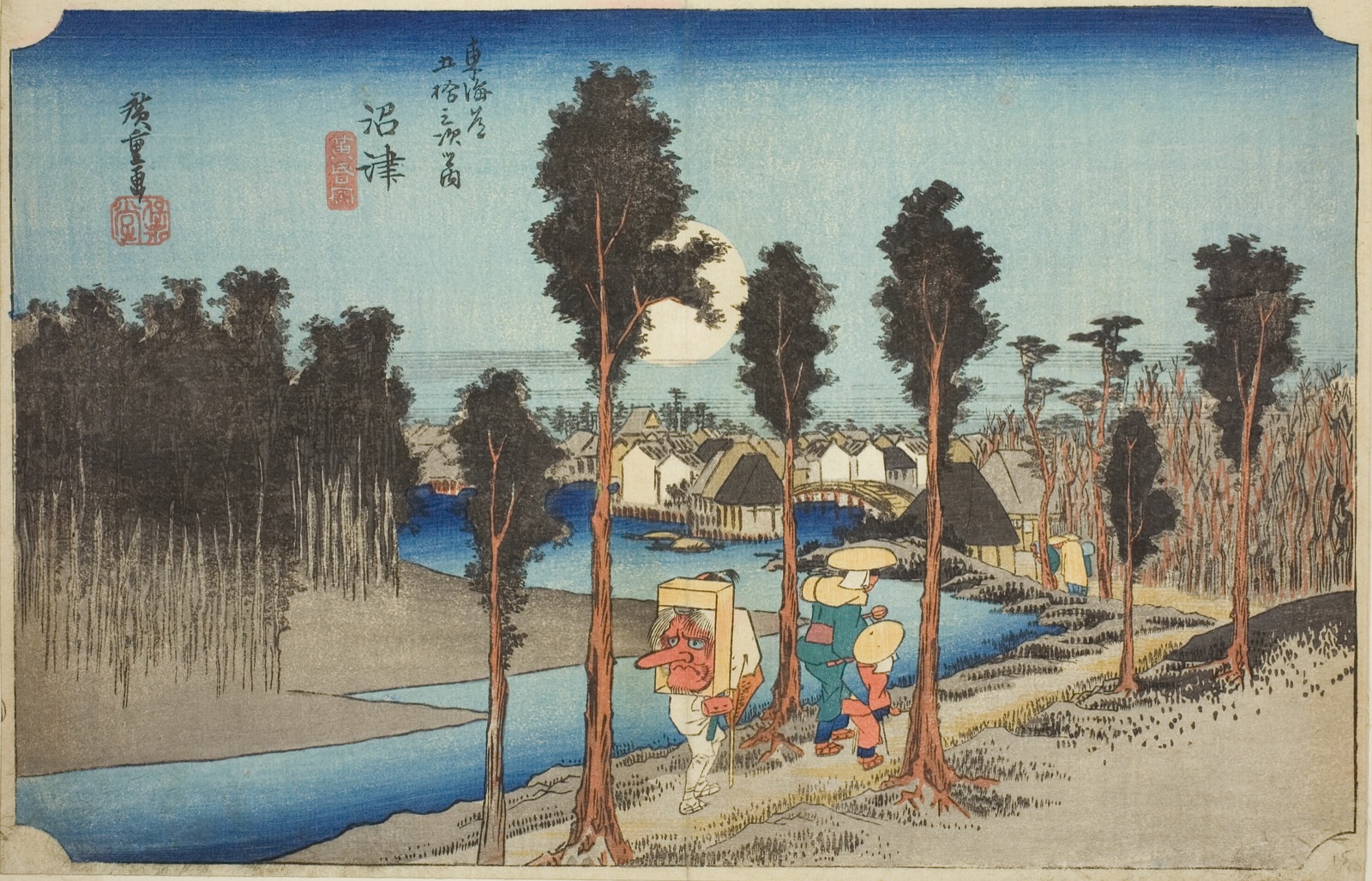
Hiroshige’s Numazu, a post town on the Tōkaidō highway. The sun has gone down and a full moon is climbing. Along the river road walks a man, and on his back is a tengu mask far larger than his own face. He was carrying it to a shrine, to offer it there.
The face on your keyboard was walking a highway on a man’s back, two centuries ago.
And a tengu is a yokai. Edo prints are full of this kind of thing — a picture that turns out to be carrying more meaning than it first shows.
4. Yokai
So what is a yokai?
It isn’t the name of one particular creature. It’s a wide word, the name of a whole category. Old tools that wake up and acquire a will of their own. Animals that gain power with age. A mountain or a river taking a shape. If it isn’t human, it belongs here.
English tends to flatten all of it into “ghost” or “monster,” but in Japanese a yokai is a different order of thing from a yūrei, the spirit of a dead person. A yokai was never human to begin with.
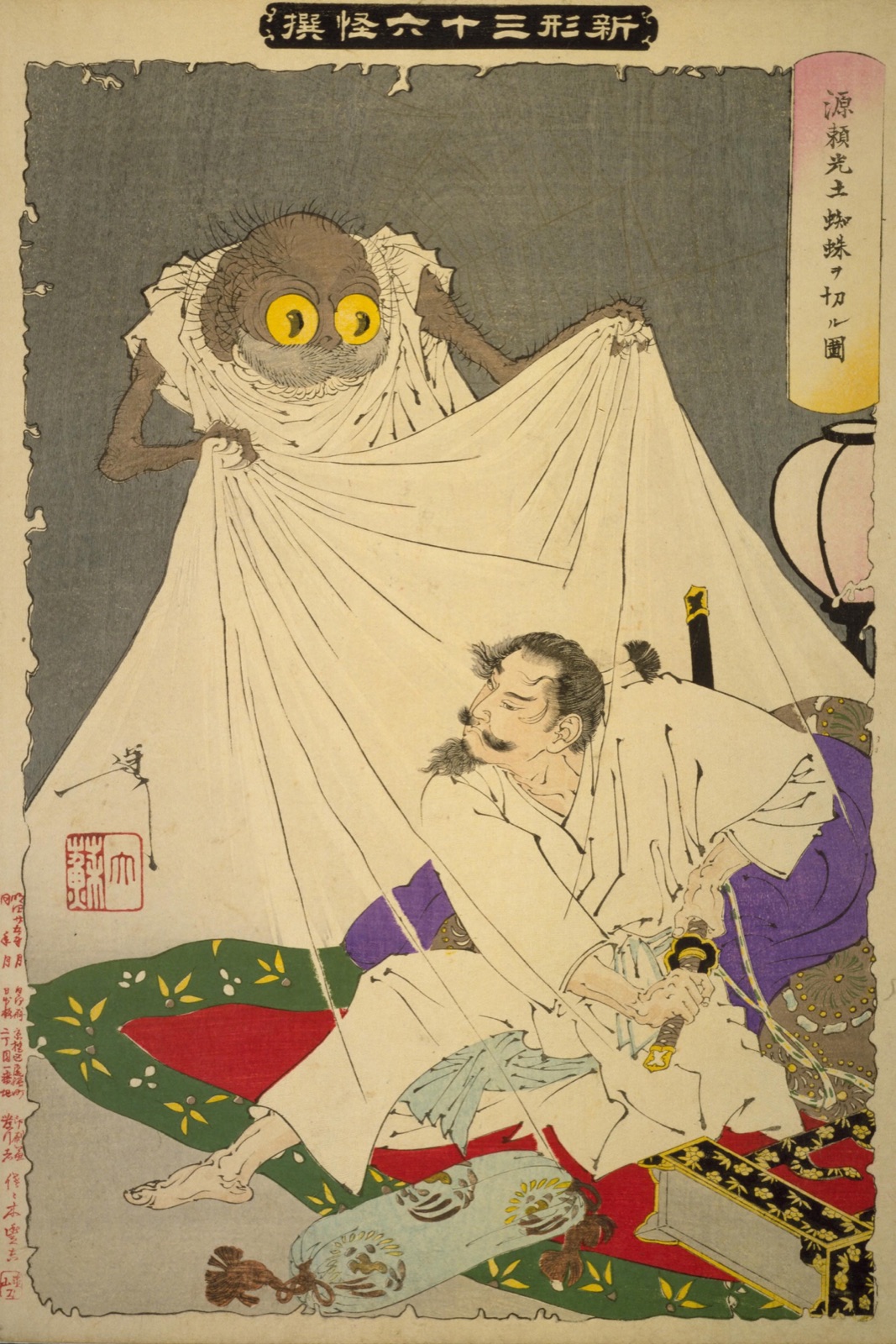
The creature here is a tsuchigumo, an earth spider. It looms over Minamoto no Yorimitsu, who lies ill in bed, spreading something white and sheet-like as if to cover him. Two yellow eyes in all that fur. Yorimitsu has sensed it: under the covers, his hand has closed around his sword.
The artist is Tsukioka Yoshitoshi, and the year is 1892 — more than two decades after the Edo period ended. The world changed. The monsters went on being drawn.
5. Bakeneko
Bakeru means to change shape by some uncanny power. Neko is simply a cat. Together: bakeneko, a cat that has changed.
Japan has held for a very long time that a cat gains power if it lives long enough. An old cat speaks. It puts a towel on its head and dances. It laps the oil from the andon, the paper-shaded lamp that lit every house. And a cat whose tail has split in two is a nekomata, which is worse.
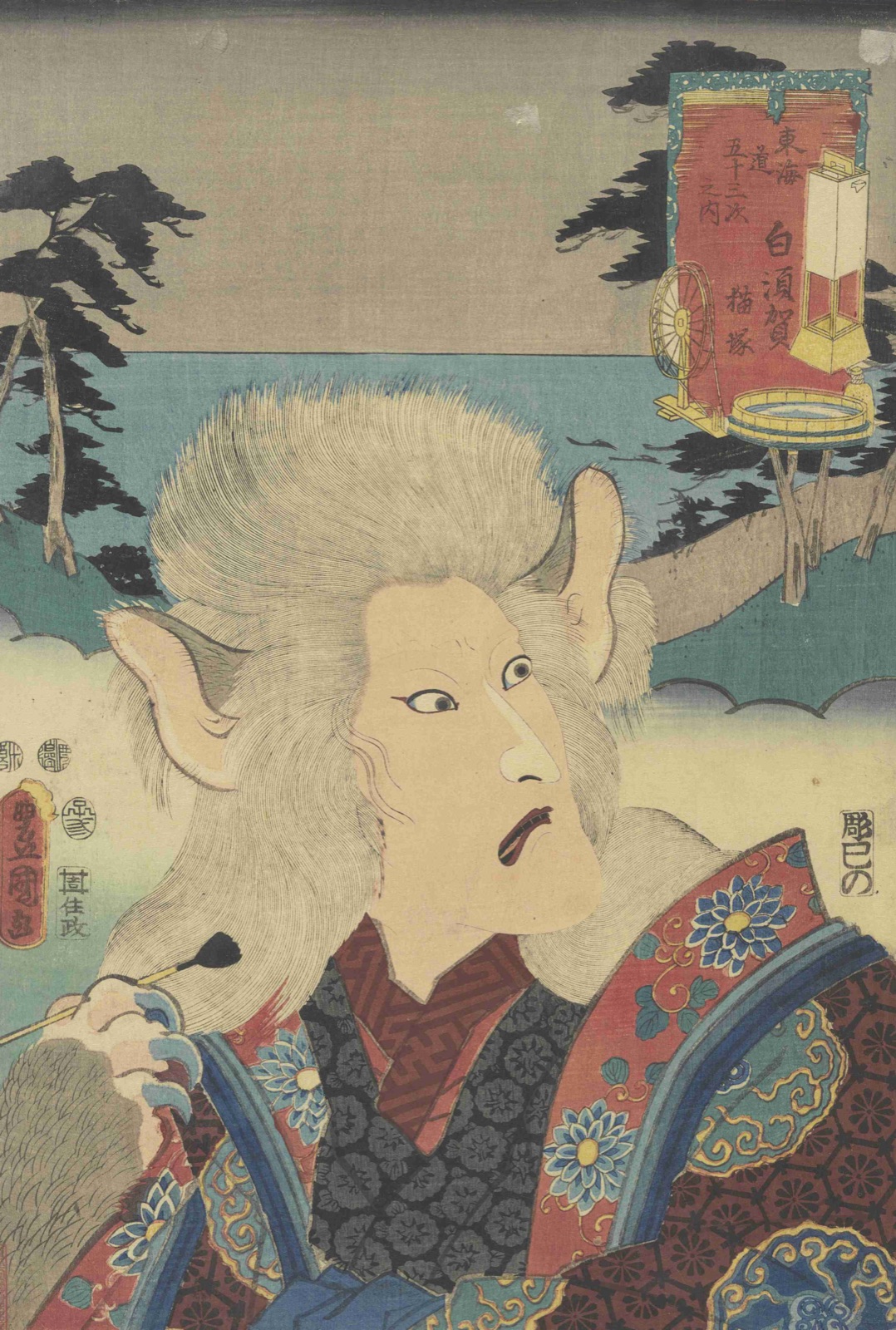
Cat-monster plays were a staple of the Edo theater. This print belongs to a series that gave each station on the Tōkaidō highway a kabuki role; the station of Shirasuka got the cat.
The ears have grown long. White fur is coming in around the face. The eyes are wide open. This face is already most of the way to being a cat’s — and the hand is still holding a pipe.
Not a person, not a cat, but the moment in between. That is where Kunisada chose to stop. (For cats drawn with rather more affection, there are always Kuniyoshi’s.)
6. Kitsune
A kitsune is not just a fox. When the word turns up in English, it almost always means the other kind.
In Japan they say that a fox living for several centuries becomes something else: it grows extra tails, and it can take human form. A beautiful woman. A traveling monk. Sometimes it deceives people; sometimes it helps them, as a messenger of Inari, the deity of rice and good fortune. Not many creatures are allowed to stand on both sides like that.
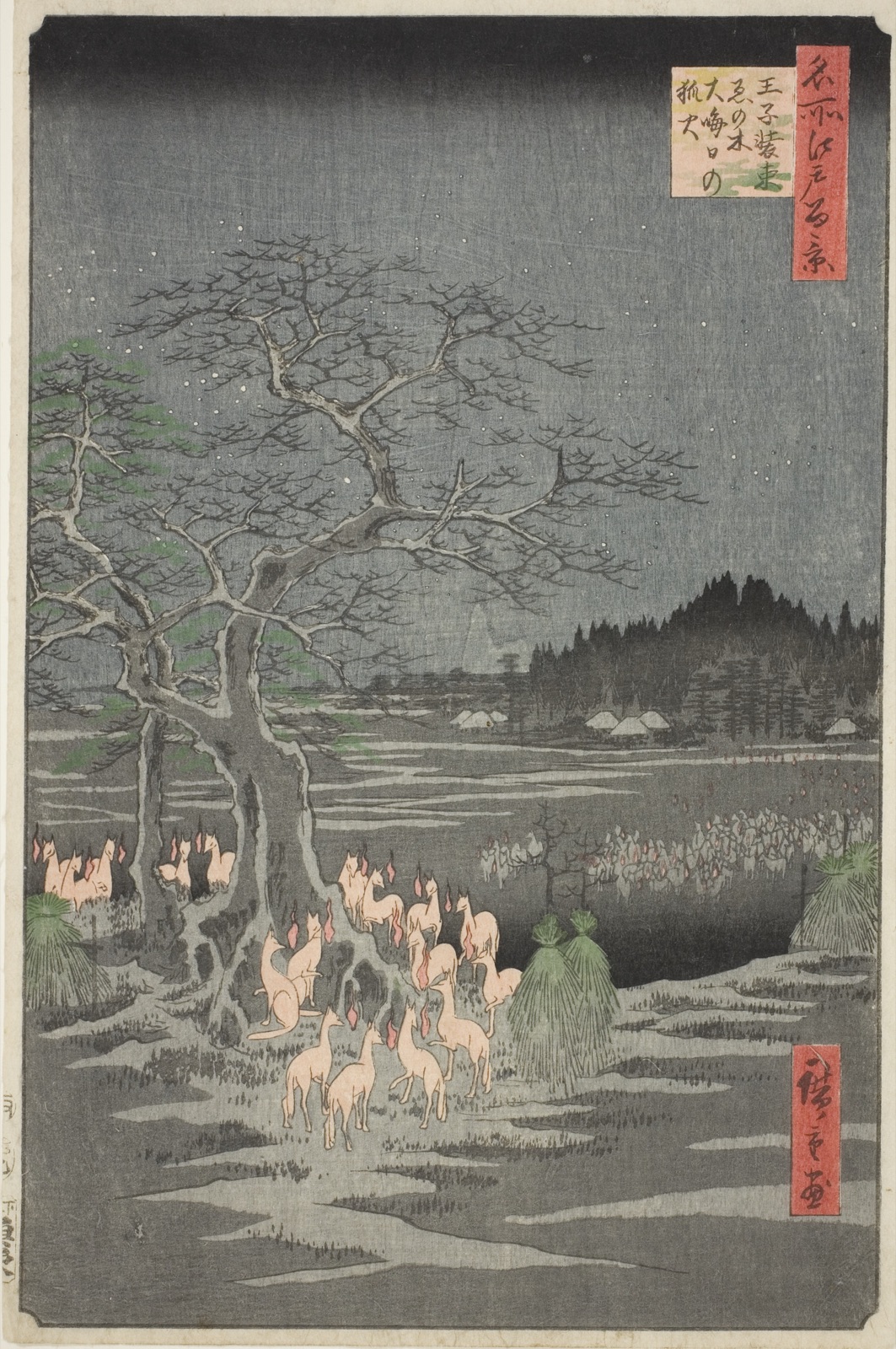
What Hiroshige drew is Ōji — north of the city, today part of Tokyo — on the last night of the year.
The story goes that on New Year’s Eve every fox in the region gathered beneath this hackberry tree, put its formal dress in order, and went to pay its respects at the Ōji Inari shrine. Each fox carried a small flame at its mouth.
There’s more to the story. The farmers nearby counted those flames. A great many meant a good harvest coming; only a few meant a poor one. Foxfire was, among other things, a way of reading next year’s rice.
Count the flames in the print, one by one. You’ll be doing exactly what the people of Edo did every New Year’s Eve. (The print comes from One Hundred Famous Views of Edo, Hiroshige’s last great series.)
7. Onryo
On is a grudge. Ryō is a spirit. An onryō is someone who died with a grudge still in them, and did not let go of it.
Ghosts come in many kinds, but the one modern horror inherited is almost always this one. The long black hair. The white robe. The figure that closes the distance without a sound. Most of what made Japanese horror films frightening to the rest of the world came from here.
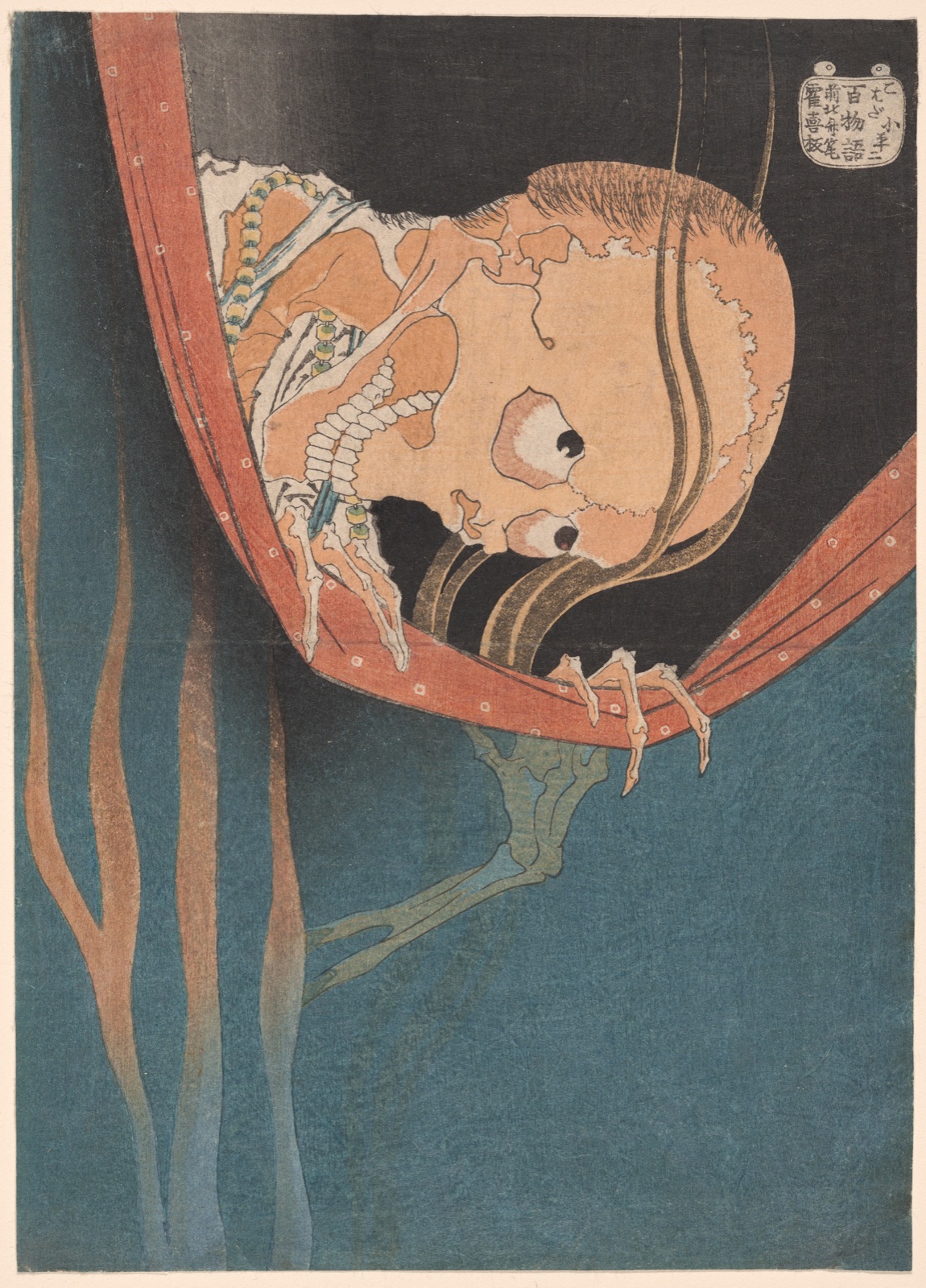
Hokusai’s subject is Kohada Koheiji, an actor who was mediocre in every role but one: he was uncannily good at playing ghosts. On tour in the north he was murdered — and here he has come back, to the man who killed him.
Bony fingers have hooked over the top rail of the mosquito net. Half the flesh is gone from the face, and an eye is still in it. He is looking down through the netting at the sleeping man. (A mosquito net, or kaya, was hung over the bed in Japanese houses on summer nights.)
Being looked at from above, through the net — I think it’s the angle that gets you.
8. Oni
The last word.
An oni has two faces.
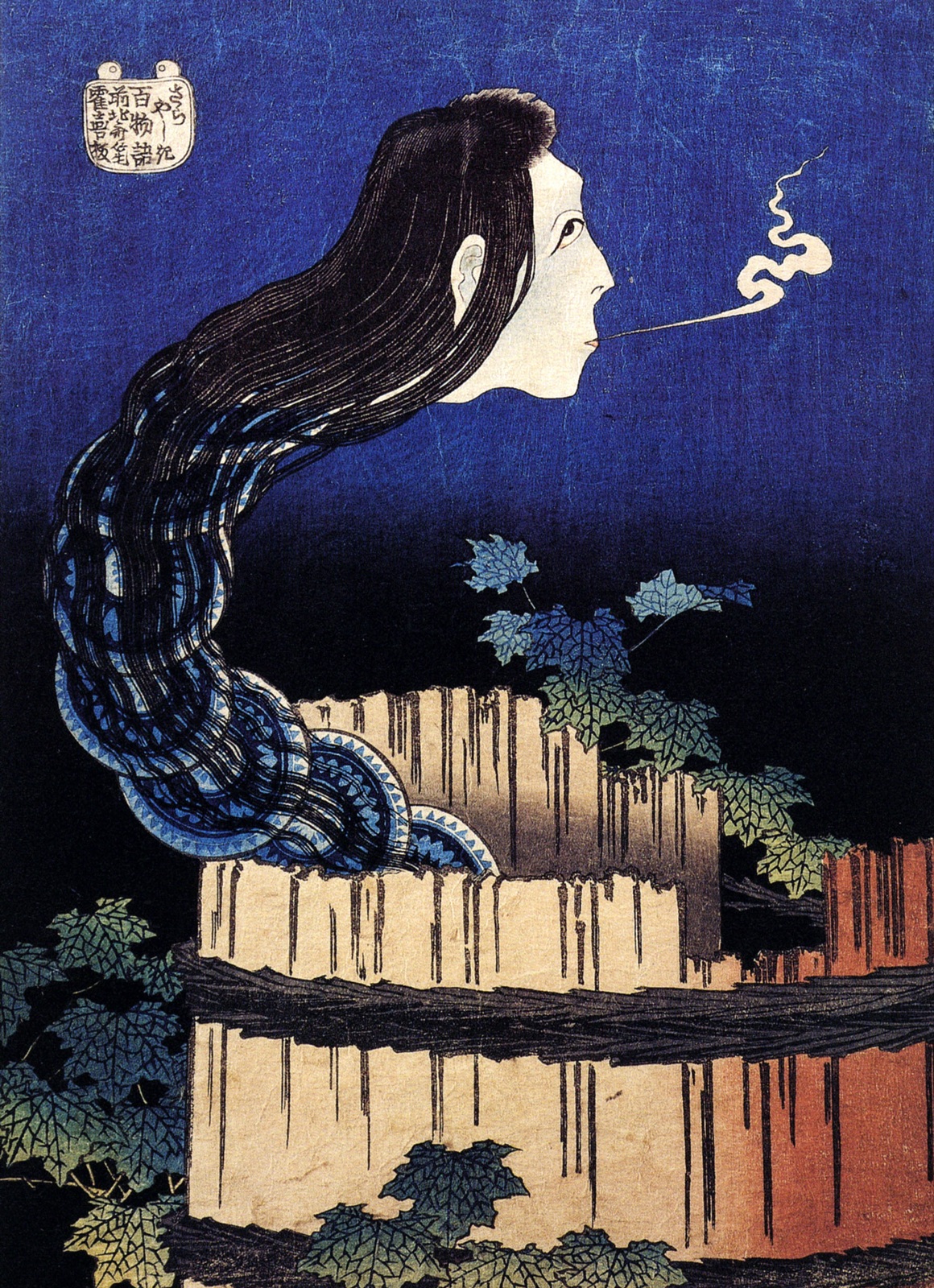
One of them gets beans thrown at it. On Setsubun, in early February, households in Japan still shout “oni out!” and scatter roasted soybeans at the door. That oni is red or blue, has horns, and is faintly comic — the kind a child draws. (It’s the face 👹 is wearing, too.)
The other one lives in stories. It carries people off, it eats them, and it exists to be cut down with a sword. Nothing comic about that one.
Even in Japan, the two can feel like different creatures altogether. But they are the same word: horned, fanged, not human. That’s the thread holding them together.
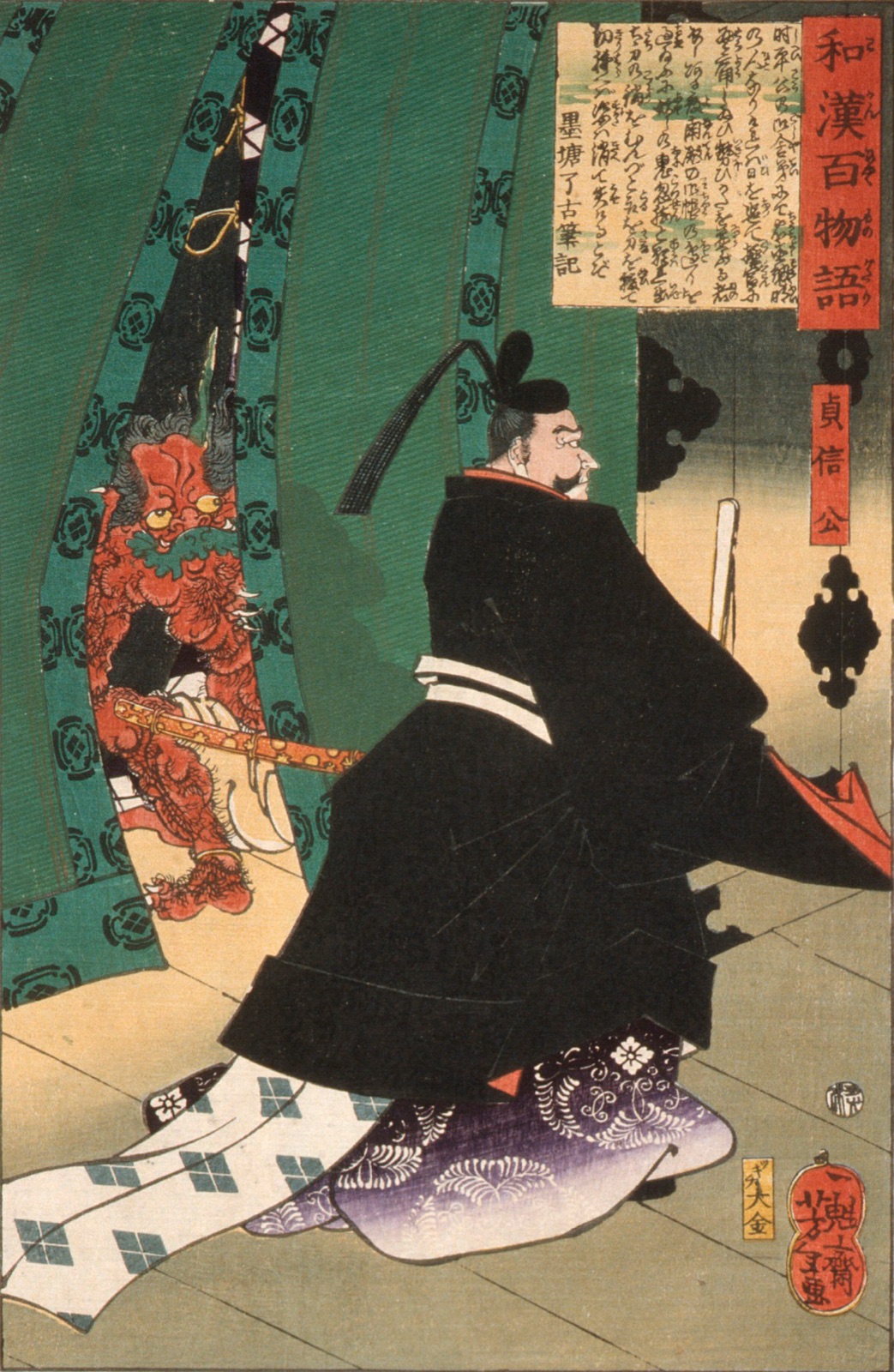
Yoshitoshi’s print shows an episode about a Heian-period nobleman, Fujiwara no Tadahira.
A red hand reaches out from behind the misu — the hanging bamboo blind that divided the rooms of a palace — and takes hold of the end of Tadahira’s sword. Tadahira’s expression does not change at all.
According to The Great Mirror, what happened next is that he drew the sword and seized the demon’s hand instead. It panicked, let go, and fled. (There is something very satisfying about an oni running away.)
And — a story about cutting down oni. You have probably watched one fairly recently.
A Final Thought
I laid the eight words out, and only then noticed something.
Manga, chibi, emoji. Ordinary words, all three. Then: yokai, bakeneko, kitsune, onryo, oni.
Five of the eight are names for monsters.
I wasn’t collecting monsters. I picked up the Japanese words that survive untranslated inside English sentences, and this is what I ended up holding.
Plenty of other Japanese words have made it into English, of course — sushi, futon, karaoke. Words for food and daily life. But narrow it to the words that traveled through manga and anime, and the company changes completely.
What crossed the ocean wasn’t decided in Japan. It was decided by the people who received it.
A word survives only where it’s needed.
Which means these eight are here because fans needed them — because there was a thing to point at, and English had no word for it.
And five of those eight are monsters.
Isn’t that something?
References
- Ōkagami (The Great Mirror), Book II, “Grand Minister Tadahira, Lord Teishin” — the encounter with the demon at the Shishinden
- Santō Kyōden, Fukushū kidan Asaka no numa (1803) — the tale of Kohada Koheiji
- Kita City Asukayama Museum, catalogue entry for New Year’s Eve Foxfires at the Changing Tree, Ōji — on counting foxfires to divine the harvest
- Tokyo Fuji Art Museum, catalogue entry for Hiroshige’s Numazu — on the tengu mask carried as a votive offering
- The Unicode Standard, Unicode Character Database (character names) and CLDR (display names)