There are artists who fit neatly into their era. And then there are artists who make you wonder how they existed at all.
Utagawa Kuniyoshi (1798–1861) was one of the great ukiyo-e masters of the late Edo period, standing alongside Hokusai and Hiroshige in the same generation. But in terms of personality — in terms of sheer uncontainable creative energy — he occupies a category of his own.
Warrior prints of breathtaking force. A skeleton the size of a building. Political cartoons slipped past government censors inside pictures of cats. And the cats themselves, rendered with an affection so obvious and so consistent that it amounts to a statement of values.
You may not know his name yet. But there’s a good chance you’ve seen his work. Once you have, it’s not easy to forget.
1. The Warriors That Made Him Famous
Kuniyoshi’s name was made by warrior prints.
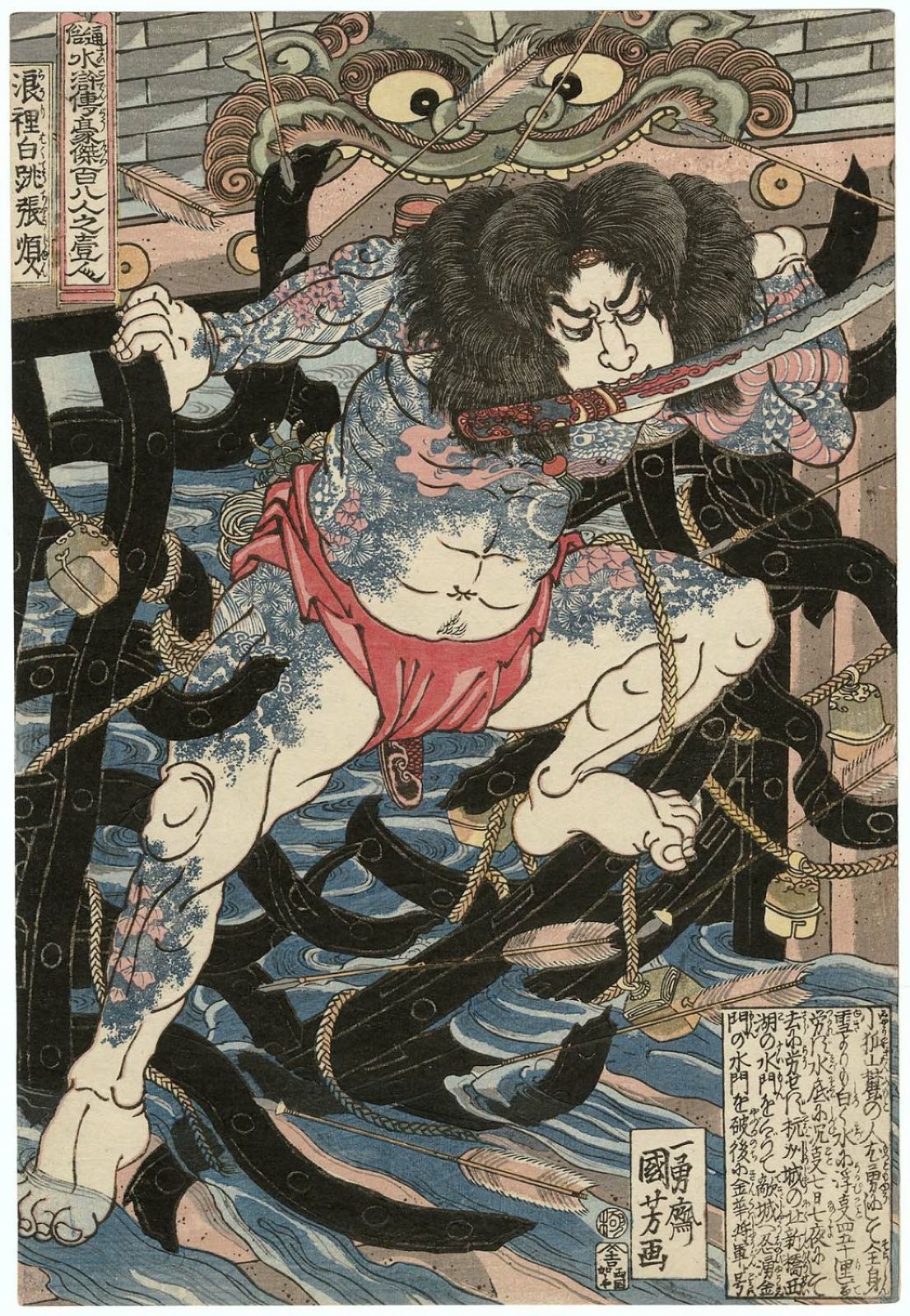
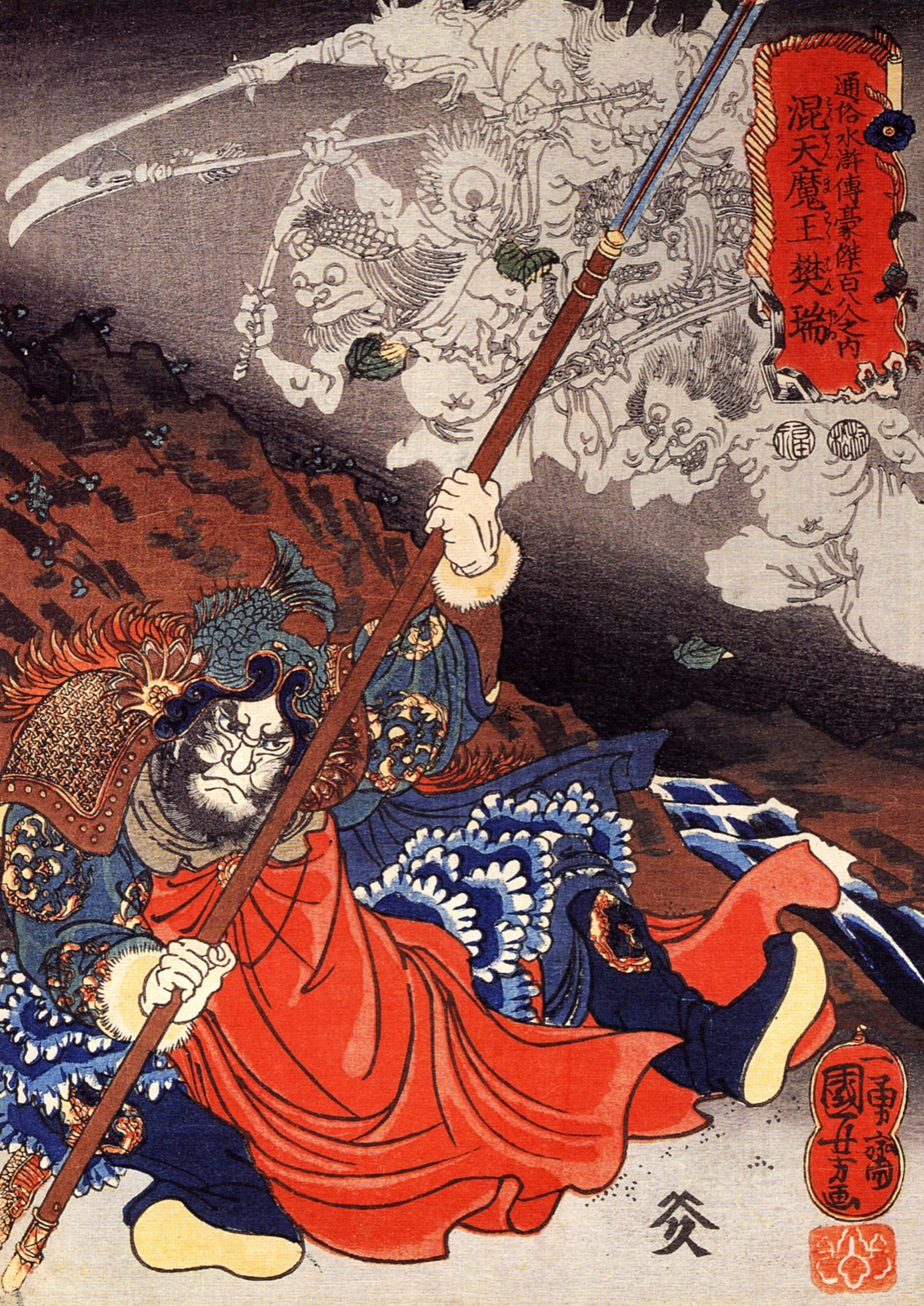
Around 1827, he published a series depicting the heroes of Suikoden — a beloved Chinese classic novel about 108 outlaw warriors — and Edo went wild for them. The prints had things that ukiyo-e warrior art hadn’t quite achieved before: genuine physical mass, a sense of bodies that weighed something, shadow and volume that may have been influenced by Western copper engravings circulating in Japan at the time.
The tattoos covering these warriors’ bodies are worth examining closely on their own — intricate, layered, almost impossible in their precision. Each figure gives the impression that something enormous is being held, barely, in check.
Edo’s audiences recognized they were seeing something new. So did I, the first time I saw one.
2. The Skeleton That Still Stops People
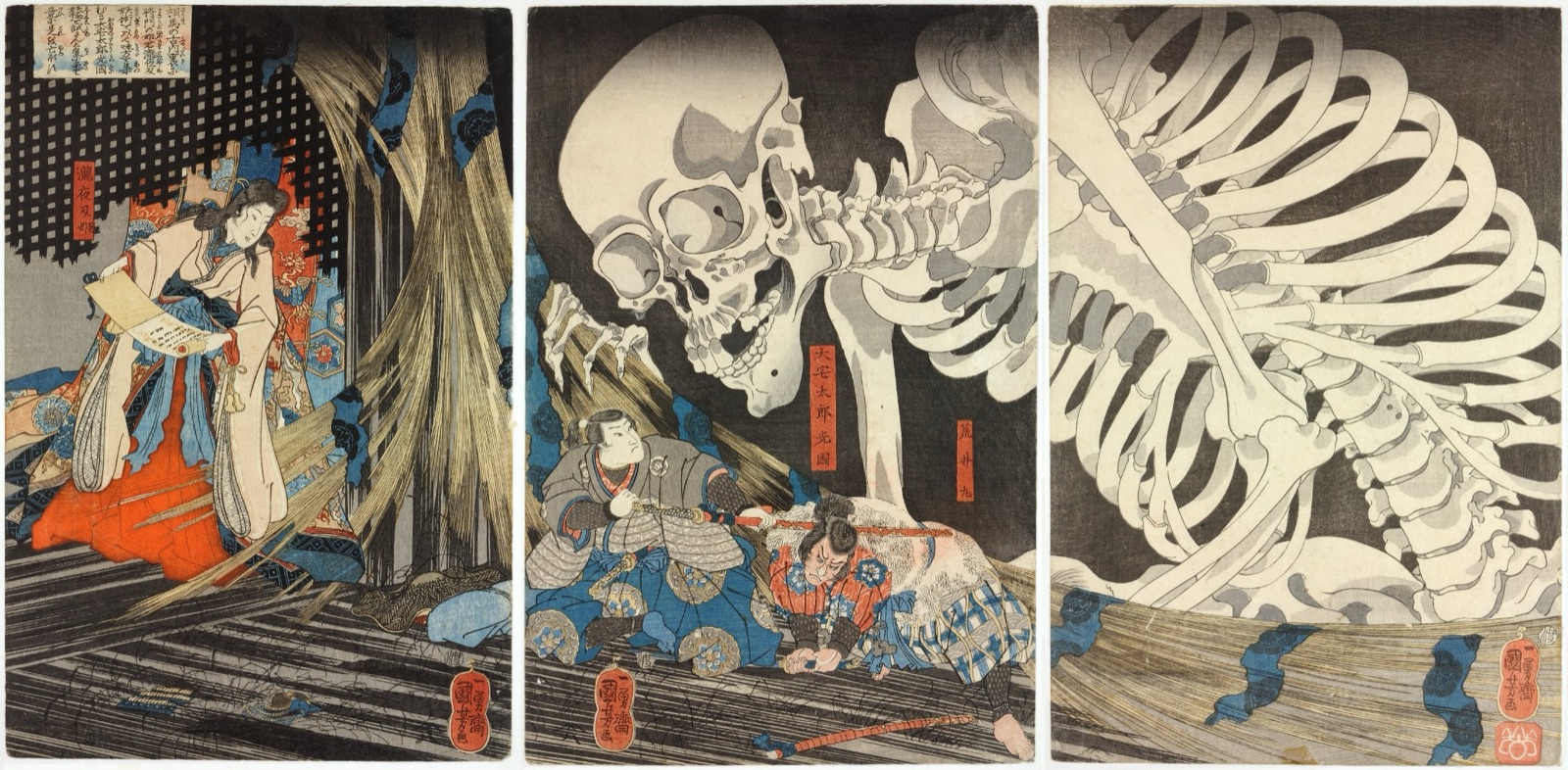
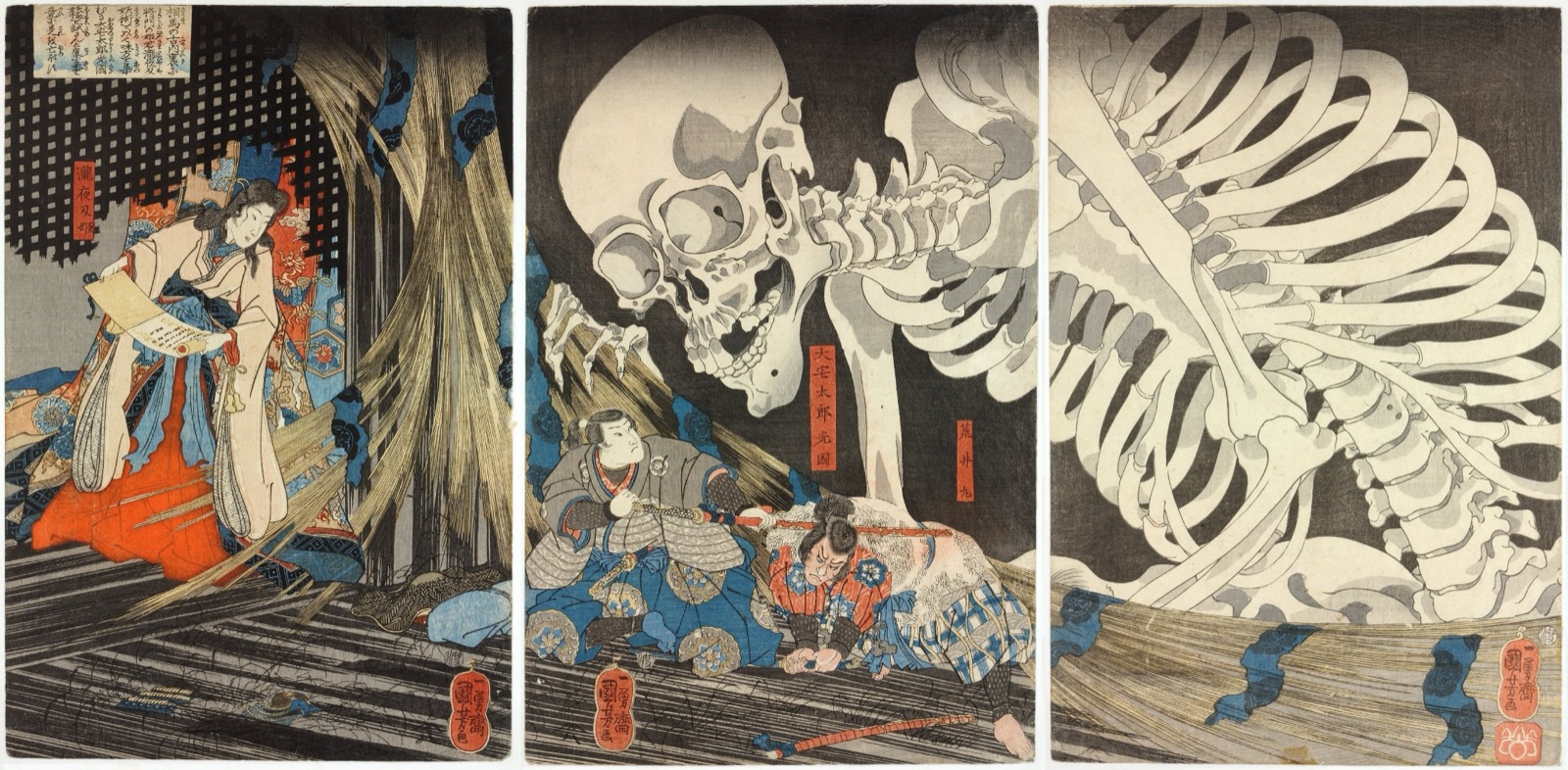
Takiyasha the Witch and the Skeleton Spectre (c. 1844–48) is the work most likely to stop a first-time viewer completely.
In a ruined palace, a colossal skeleton rises — a three-panel triptych in which the figure towers over the warriors confronting it, its bones rendered with meticulous, almost clinical precision. It isn’t simply large. It is alive in the way Kuniyoshi understood alive: each bone present and described, something coiled behind those empty eye sockets, the whole thing in motion.
The comparison sometimes made to Edgar Allan Poe isn’t wrong — there is a Western Gothic quality to the image, a pleasure taken in beautiful darkness that crosses cultural lines. What’s remarkable is that Kuniyoshi arrived at this sensibility without direct exposure to Western Romantic art. He found his way there on his own.
3. The Cats
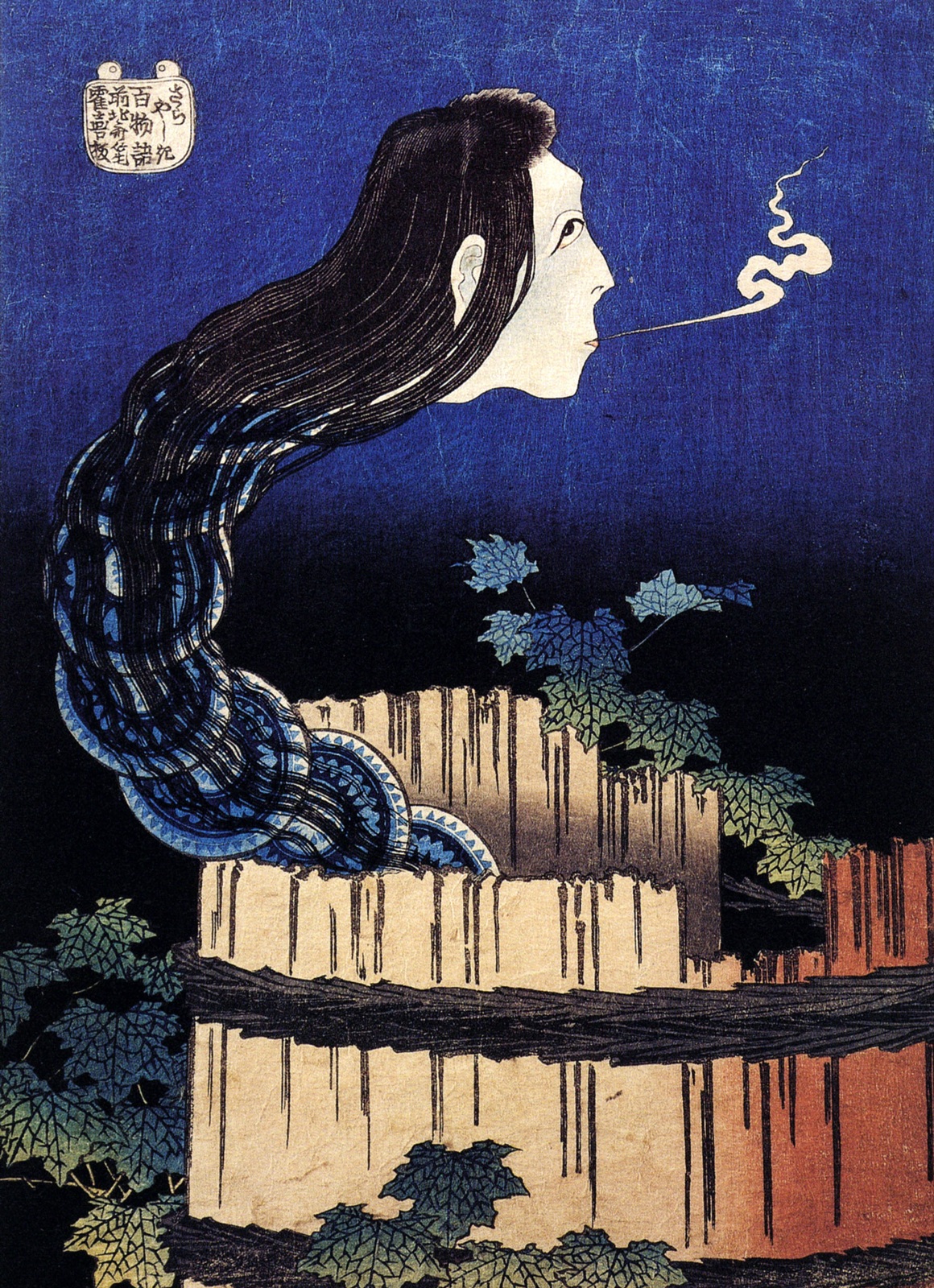
Kuniyoshi loved cats. This is well established. What is harder to convey is the degree to which he loved them.
His studio reportedly housed multiple cats at any given time. He was said to carry kittens tucked into the sleeves of his kimono while he worked. Cats on his lap, cats at his meals, cats in the margins of his professional life in every possible way.
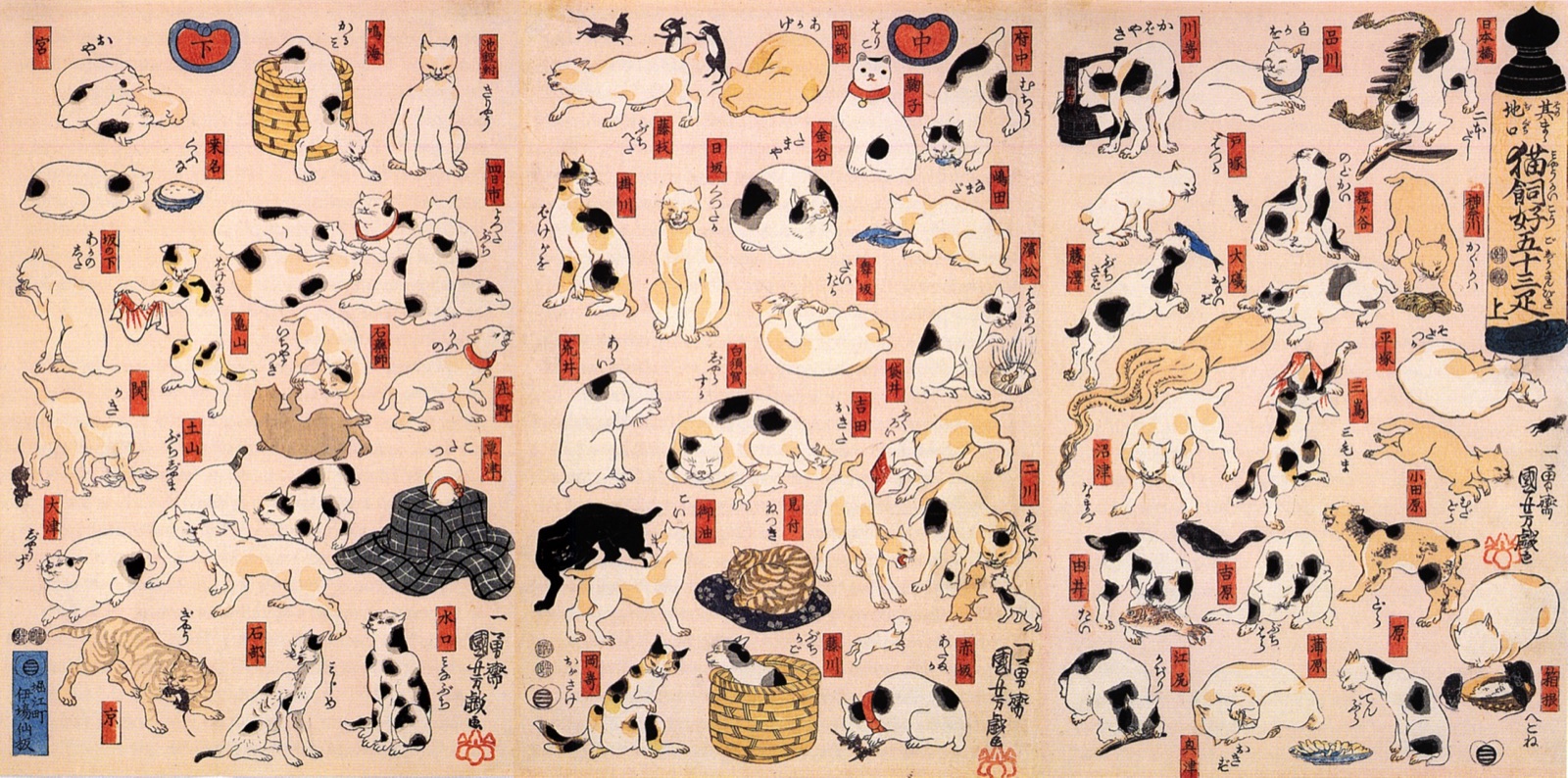
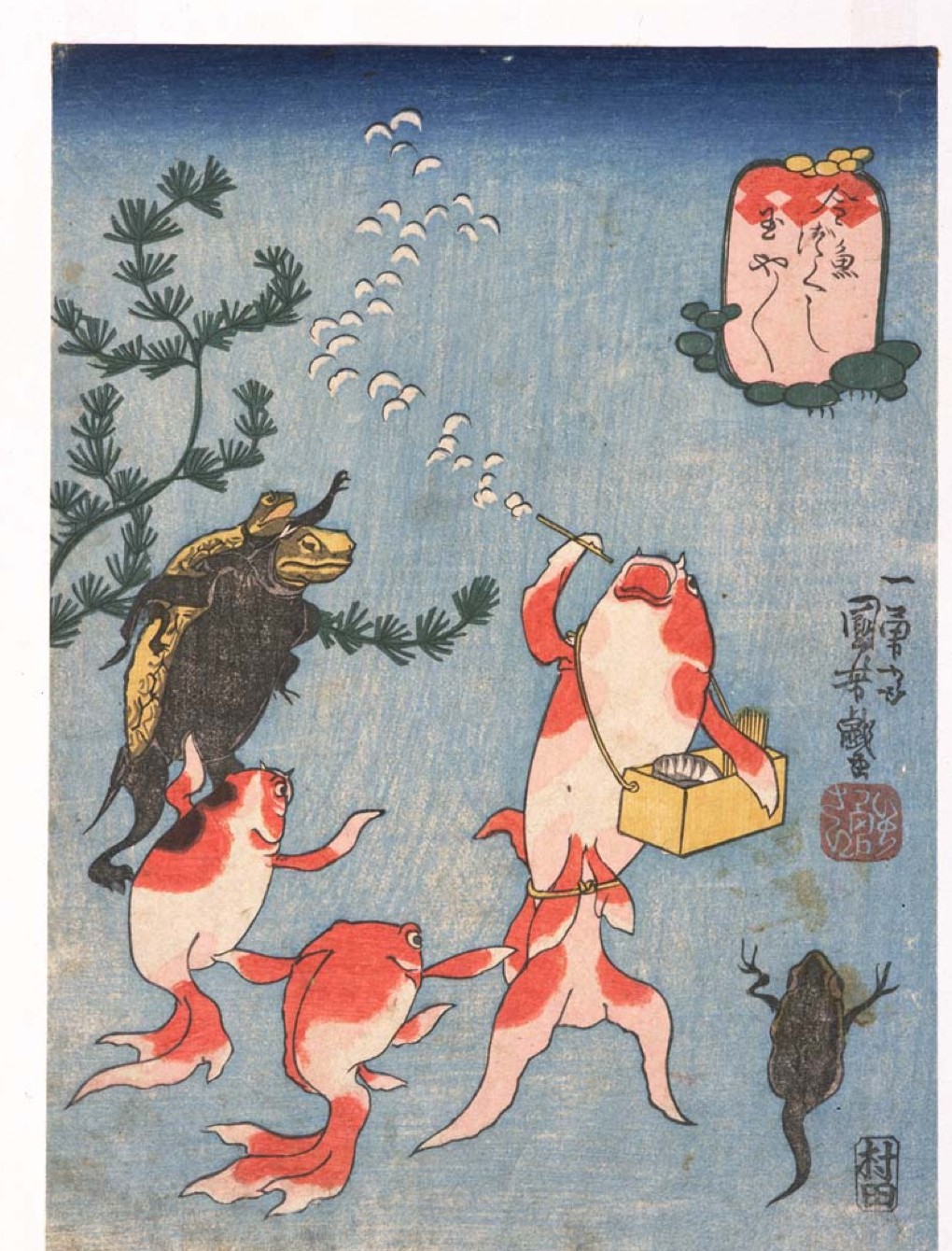
And this love is not incidental to the work — it’s everywhere in it. Kuniyoshi’s cats do not merely sit and look decorative. They have expressions. They have opinions. They are up to something. There are cats performing kabuki, cats running fish stalls, an entire Fifty-Three Stations of the Tōkaidō populated exclusively by cats. The wit in these prints is consistent and inexhaustible.
I will be honest: I lose track of time looking at the cat series. If you love cats — and a remarkable number of people around the world do — this is where you should start.
4. Satire That Slipped Past the Censors
During the Tenpō Reforms (1841–43), the Edo shogunate cracked down hard on popular art: actor prints restricted, beauty prints restricted, any image deemed to corrupt public morals suppressed. Many artists simply changed subjects.
Kuniyoshi chose a different approach.
He embedded political criticism inside apparently innocent images. One famous example shows an assemblage of cats arranged to form a human face — understood by contemporaries as a portrait of a powerful official Kuniyoshi had no other way to criticize. If you can’t say it directly, say it so that only those who need to understand will understand.
The shogunate tried to prosecute him. They couldn’t quite make it stick — it was, after all, just cats. The parallel with internet meme culture — the use of innocuous imagery as a vehicle for commentary that official channels can’t easily suppress — is one that doesn’t require much imagination to draw. People were doing this in Edo, two hundred years ago.
5. Why He Still Feels Alive
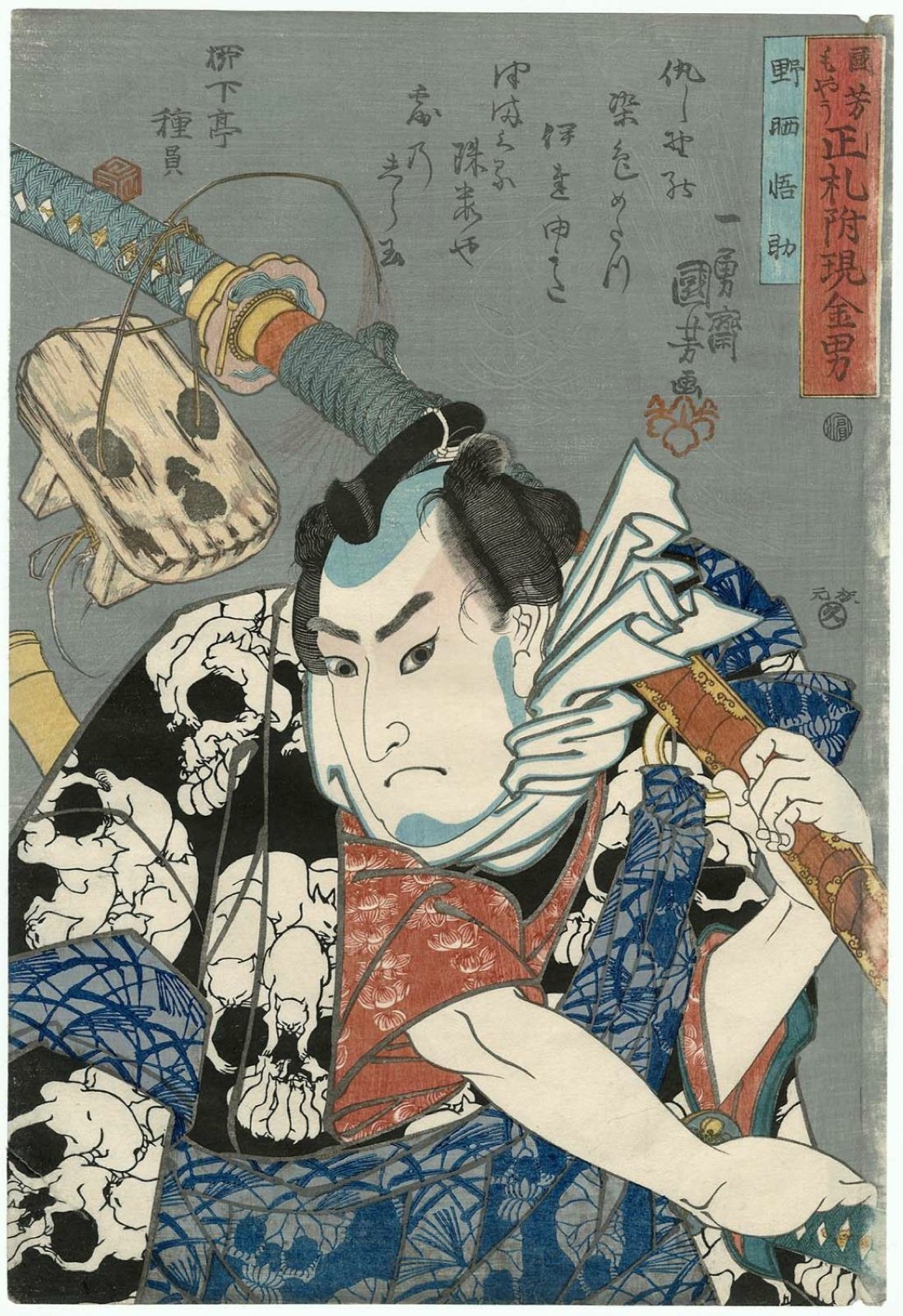
Kuniyoshi died in 1861. More than 160 years later, his images are on T-shirts and phone cases, in museum gift shops, circulating on social media among people who have never heard his name but recognize something in what they’re looking at.
The reason, I think, is that irreverence and genuine craft are rarely found together at this level. The works that mock power are also technically extraordinary. The skeleton is terrifying and beautiful. The cats are funny and somehow knowing. The warrior prints are overwhelming in a way that feels earned rather than performed.
Any one of these things would make an interesting artist. All of them in the same person makes Kuniyoshi.
6. Where to See His Work
In Tokyo, the Ota Memorial Museum of Art (Harajuku) holds regular Kuniyoshi exhibitions — the best opportunity to see a substantial collection gathered in one place.
Online, the Metropolitan Museum of Art’s collection includes warrior prints and satirical works viewable in high resolution, free of charge. That’s a very good place to start.
A Final Thought
Hokusai’s greatness, Hiroshige’s lyricism — these are the two peaks of ukiyo-e that everyone mentions.
But knowing Kuniyoshi widens what you understand ukiyo-e to be. This art form contained not only transcendent beauty but laughter, monstrousness, resistance, and — running through all of it — an apparently uncontrollable love of cats.
Edo’s people laughed at his prints, and were frightened by them, and caught the political jokes and allowed themselves a quiet smile. That was ukiyo-e too.
References
- Ota Memorial Museum of Art, Kuniyoshi exhibition catalogues
- The Metropolitan Museum of Art, Kuniyoshi collection — metmuseum.org
Image Credits
- Cover / Section 1: Utagawa Kuniyoshi, Zhang Shun, the White Streak in the Waves, from One Hundred and Eight Heroes of the Popular Water Margin, c. 1827–30 — Public domain via Museum of Fine Arts, Boston
- Section 1: Utagawa Kuniyoshi, Konseimao Hanzui, from One Hundred and Eight Heroes of the Popular Water Margin, c. 1827–30 — Public domain via Wikimedia Commons
- Section 2: Utagawa Kuniyoshi, Takiyasha the Witch and the Skeleton Spectre, c. 1844–48 — Public domain via Wikimedia Commons
- Section 5: Utagawa Kuniyoshi, Nozarashi Gosuke, c. 1845 — Public domain via Museum of Fine Arts, Boston