There’s More Than Meets the Eye
When you stand in front of a ukiyo-e print in a museum, what do you actually do?
You think: beautiful. You think: the colors. And then you move on to the next one.
That’s a shame, honestly.
Ukiyo-e prints are filled with hidden layers that a quick glance will never reveal. A pine tree in the corner. The pattern on a kimono. The way a woman’s hair is tied. The small objects scattered through a scene. People in Edo would have read these details — catching a knowing smile here, a moment of genuine surprise there, the occasional gasp of recognition.
Ukiyo-e was not just an art to be seen. It was an art to be read.
During the Edo period (1603–1868), ukiyo-e prints occupied roughly the same place in daily life that posters and magazines do now. A single print cost about as much as a bowl of noodles. Literacy rates in Edo were remarkably high for the era, and decoding the meaning layered into an image was a natural, everyday pleasure for townspeople.
The artists knew exactly what they were doing.
Rather than simply depicting what the eye could see, they used a pine tree to whisper “longevity,” a kimono pattern to signal “this woman is a courtesan,” and a flower-viewing scene to secretly echo a famous moment from classical literature — all at once. That kind of intellectual play was one of ukiyo-e’s great pleasures.
In this article, we’ll explore that pleasure across five themes: nature as symbol, the art of visual allusion, visual riddles, what a kimono reveals about its wearer, and the ingenious ways artists slipped messages past government censors.
After reading this, try standing in front of a ukiyo-e print again. You may find yourself seeing things you never noticed before.
That Pine Tree in the Background Is Not Just a Pine Tree
The nature in ukiyo-e is never merely background.
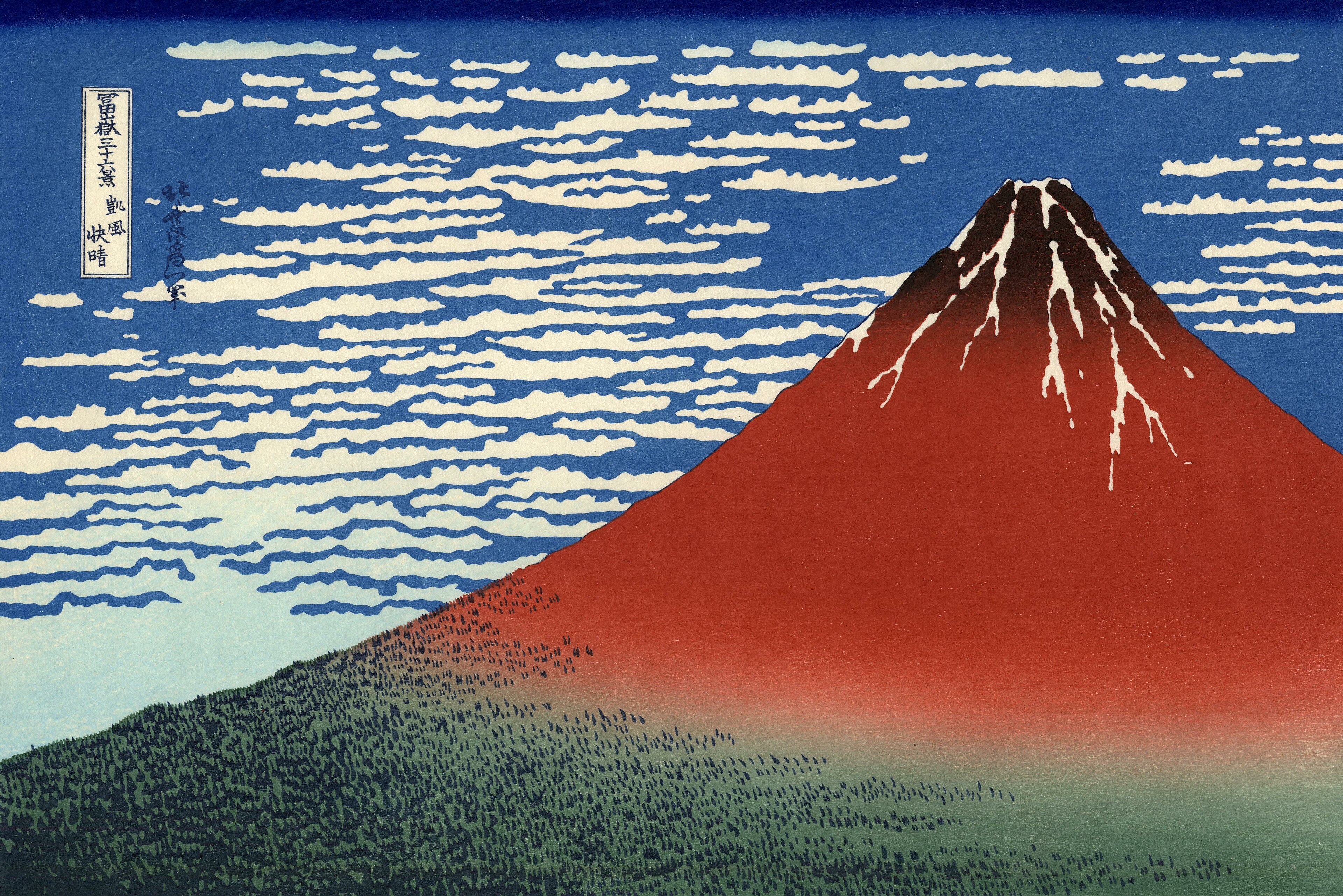
Pine trees, cranes, tortoises, cherry blossoms, waves, Mount Fuji — these were symbols that every person in Edo instantly recognized, deployed in prints the way we now use emoji: shorthand for meanings that didn’t need to be spelled out. The artists were painting in a visual language their audience already knew by heart.
The Pine: Eternity and Long Life
The pine stays green through winter when everything else dies back. In Japan, that has long made it a symbol of longevity and enduring prosperity. When a pine appears in a ukiyo-e print, it often signals something elevated about the setting or the person depicted — this place is special, this person is noble.
The same feeling is behind why pine branches appear in New Year’s decorations in Japan to this day.
The Crane and the Tortoise: Auspiciousness, Paired
In Japan, there’s a saying everyone learns as a child: “A crane lives a thousand years; a tortoise lives ten thousand.” When these two appear together in a print, you can almost always read it as a celebration — a wedding, a festival, a banquet in honor of someone’s longevity. One or both tend to appear somewhere in any scene of formal joy.
Cherry Blossoms: Beauty and Impermanence
For Japanese people, cherry blossoms have never simply been pretty flowers. They bloom for barely a week before falling — and that brevity is precisely the point. The cherry blossom’s beauty is inseparable from its transience.
When ukiyo-e depicts a hanami — a flower-viewing party — the scene is joyful on the surface, but there’s a quieter current running beneath: this, too, will end. If a print of people celebrating beneath the blossoms carries a faint note of melancholy, it isn’t accidental. That feeling was woven in deliberately.
Waves and Mount Fuji: What Hokusai Sent to the World
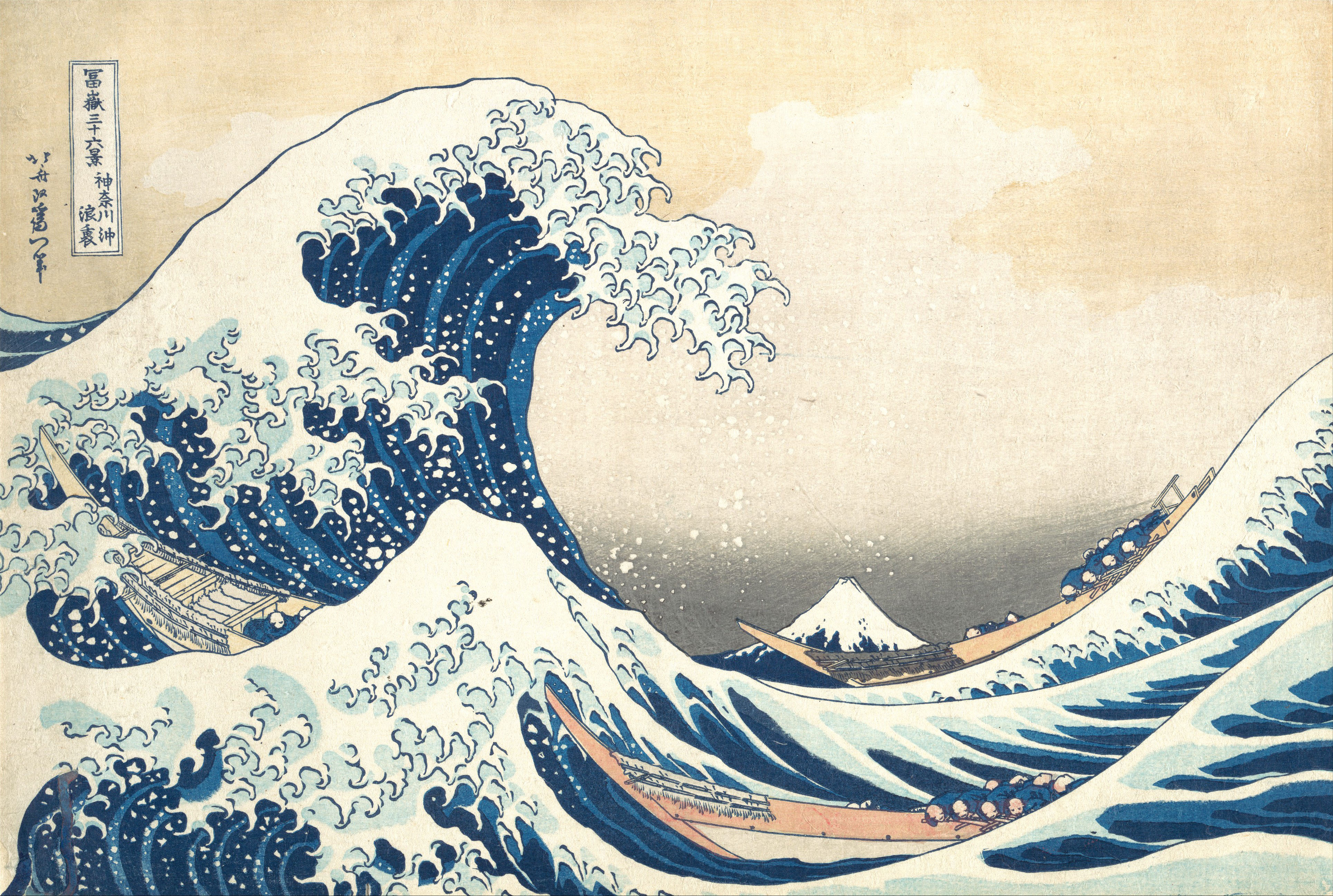
Think of Hokusai’s The Great Wave off Kanagawa. That wave is not simply rough seas.
Hokusai painted the wave as pure, living energy — surging, unstoppable. Then he placed Mount Fuji in the distance behind it: immovable, silent, utterly calm. The ferocity of the wave against the stillness of the mountain. That contrast is the heart of the image.
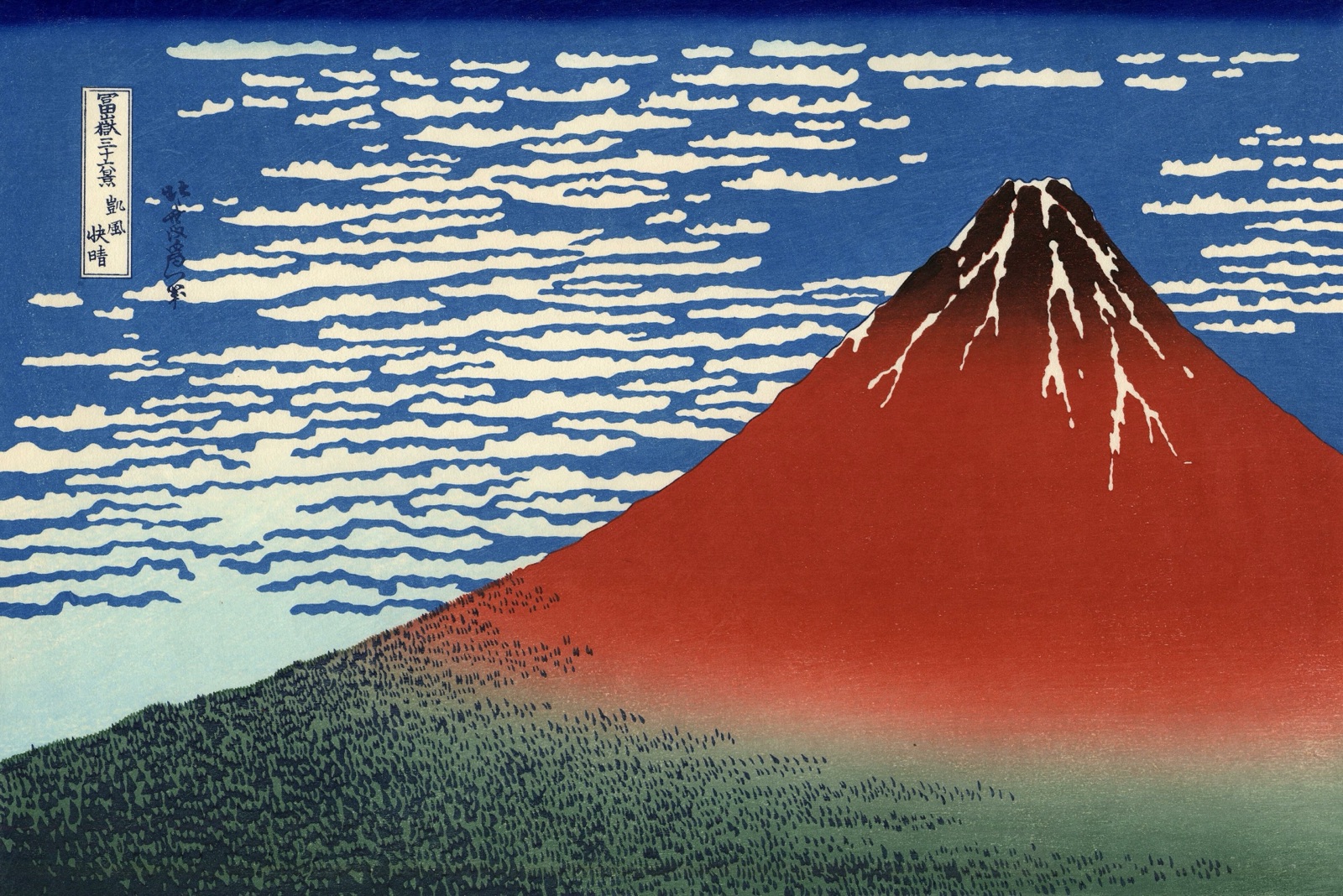
Mount Fuji held a sacred place in Japanese life long before Hokusai. His lifelong devotion to painting it wasn’t just landscape painting — it was an obsession with what the mountain represented: something like Japan itself, something like permanence.
Once you see it this way, the natural world inside a ukiyo-e print starts to feel less like scenery and more like vocabulary.
Those Who Know, Know: Layering Classical Japan onto Edo Life
Have you come across the Japanese word mitate (見立て)?
Literally, it means “to liken” — to take one thing and express it through the image of another. In the world of ukiyo-e, mitate was a wildly popular intellectual game.
Consider Hanamurasaki, an oiran painted by Keisai Eisen. She stands against a branch of cherry blossoms, wrapped in an elaborate kimono — at first glance, a straightforward beauty print from the Yoshiwara, Edo’s licensed entertainment quarter.
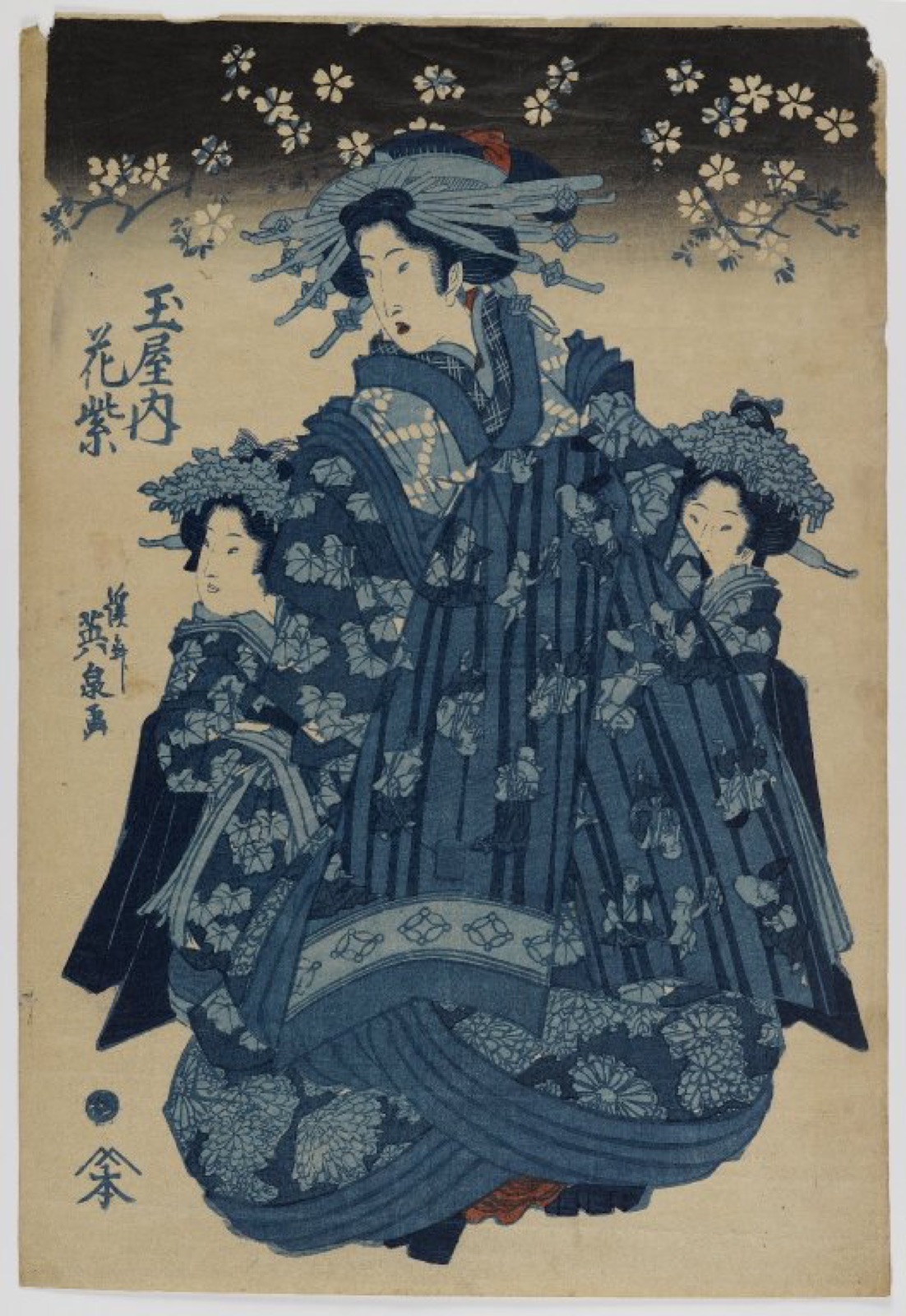
But look at the name: Hana-murasaki — “Flower Purple.” The word murasaki instantly evokes Murasaki no Ue, the great love of Prince Genji in The Tale of Genji, Japan’s eleventh-century literary masterpiece. A courtesan of the Yoshiwara, reborn in the image of a Heian princess. The cherry blossoms behind her add one more layer of classical grace.
Those who knew, knew. Those who didn’t saw a beautiful picture. That quiet understatement was considered the height of elegance.
This approach was common across beauty prints of the Yoshiwara.
Utamaro and Kunisada depicted these women as “wise women” and “heroines of virtue” drawn from Chinese and Japanese classical tales. Taking a woman of low social standing and layering the image of a celebrated historical figure onto her added depth, irony, and humor to the image all at once. It was sophisticated work.
Mitate wasn’t unique to painting, either.
It lived in haiku as honkadori — the art of weaving in a classical poem so that readers who recognized it heard two things at once. It lived in rakugo comedy as parody. By contemporary standards, it has something in common with memes, or with fan fiction: the pleasure of a shared reference that rewards those who catch it.
Ukiyo-e was built on exactly this kind of cultural participation.
If you’ve ever stood in front of a print thinking, this composition feels strangely familiar — that instinct is probably right.
Can You Decode This Print? Edo’s Visual Riddles
Let’s talk about something even more playful.
Have you heard of hanji-e (判じ絵)? It’s a type of visual puzzle: you look at the images in a print, string together their sounds, and arrive at a word or phrase. A visual riddle, Edo-style.
For example: a picture of an eye (me) next to a picture of a sea bream (tai) gives you me + tai = medetai — “auspicious” or “congratulations.” Simple, but satisfying when you get it. From children to adults, hanji-e was a beloved form of popular entertainment.
Utagawa Kuniyoshi was one of the artists who pushed this word-play to extraordinary lengths.
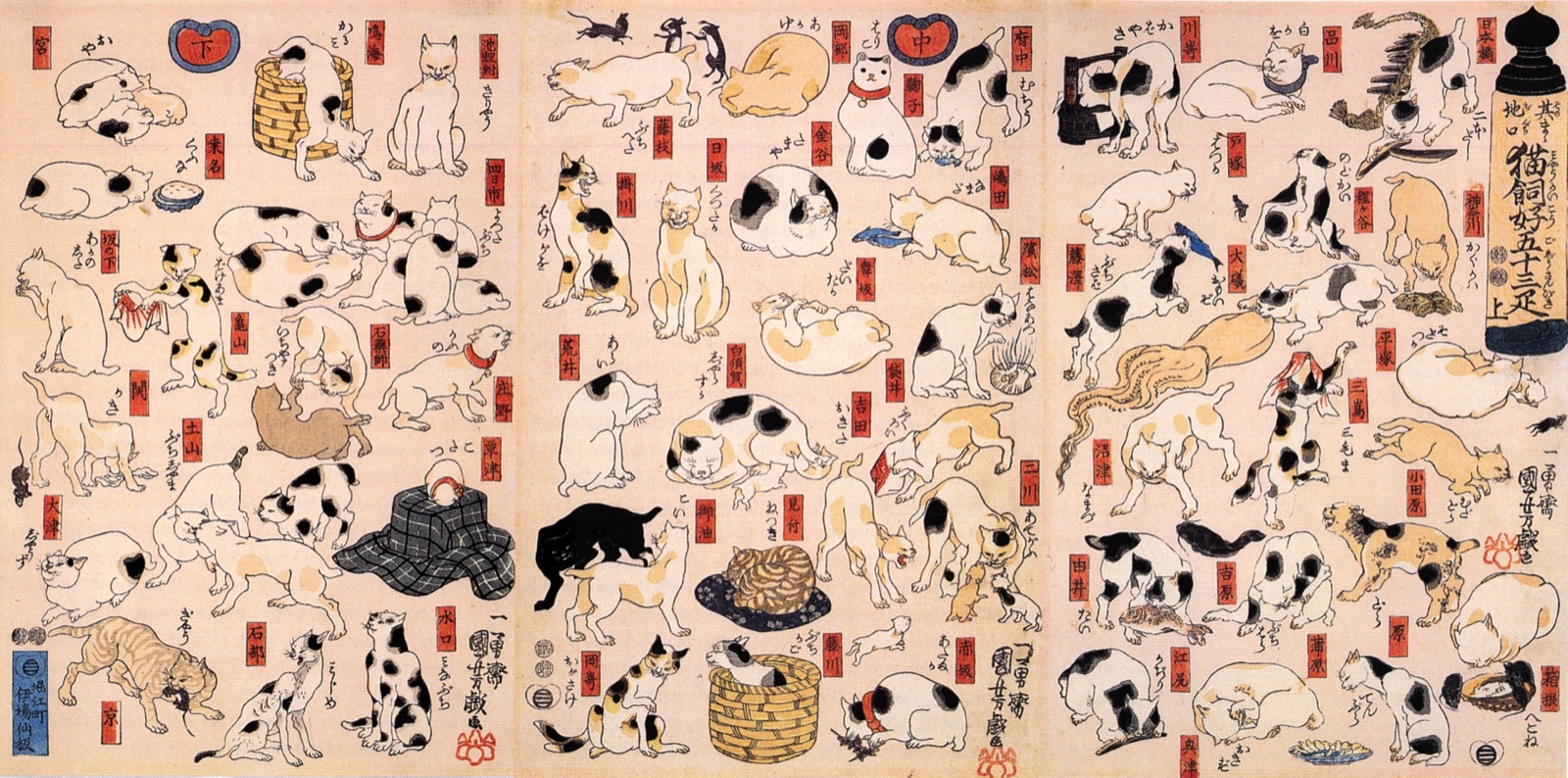
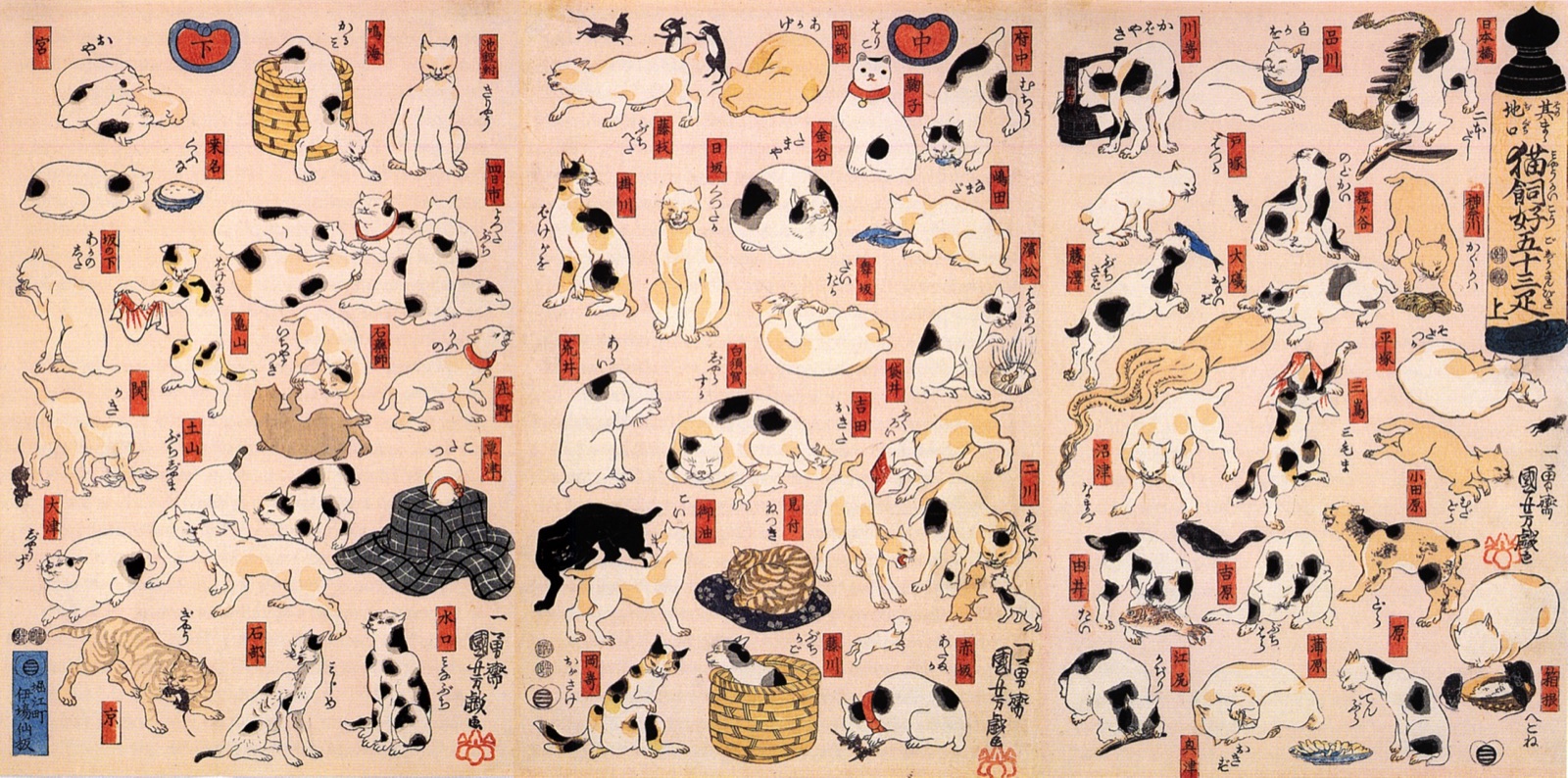
In Cats Suggested as the Fifty-three Stations of the Tōkaidō, the famous fifty-three post towns along the Tōkaidō highway are each represented — not by words, but by cats. Each cat’s pose, action, or situation evokes the name of a station: a cat straining to climb a steep slope for Hakone, a cat gazing out at the sea for Yui. The idea of conveying place names through cat behavior alone is pure playfulness — and doing it fifty-three times over is, frankly, an achievement.
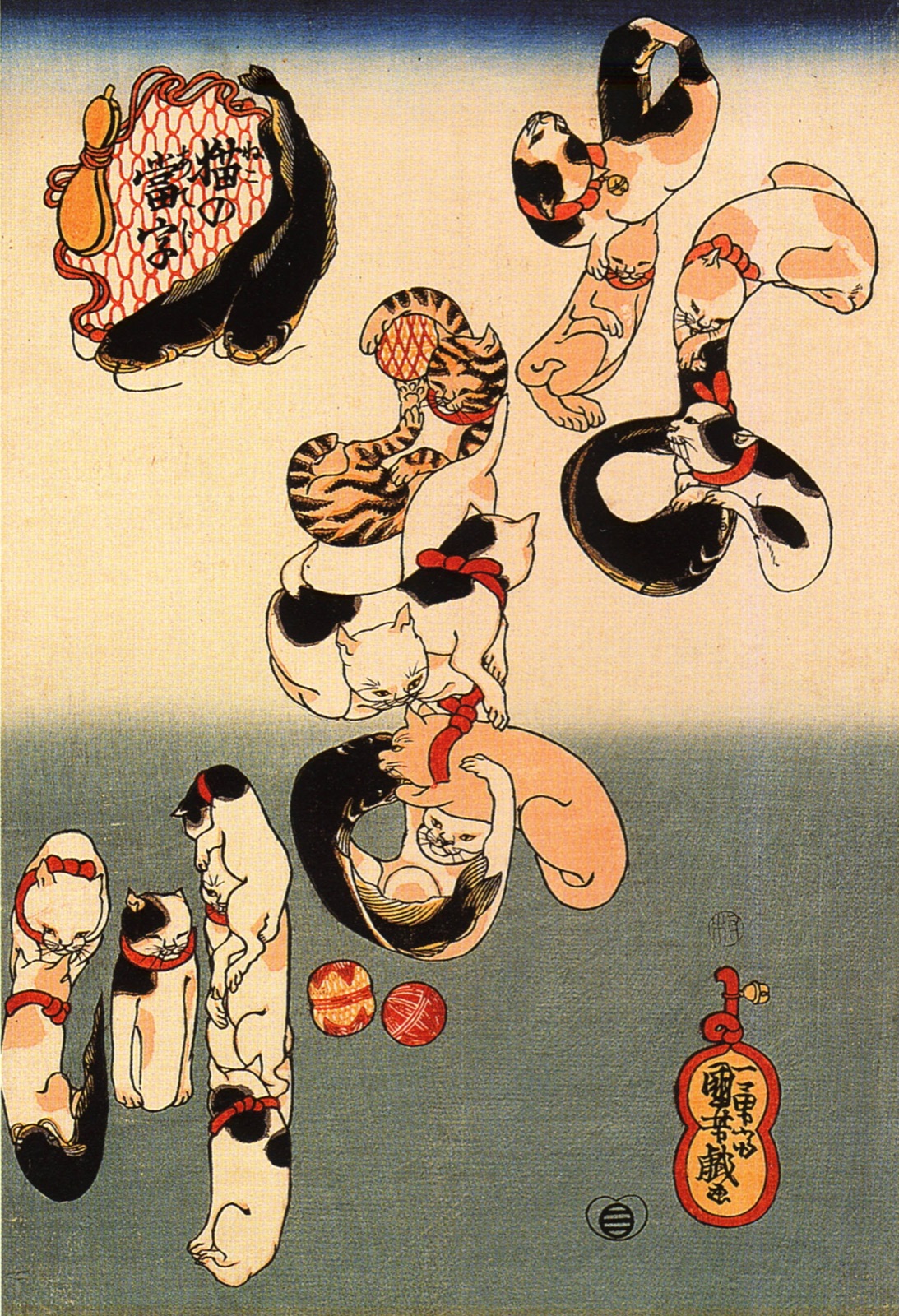
Then there is his Cats as Hiragana Characters (Neko no ateji) series, where the cats’ bodies actually form the shapes of Japanese syllabic characters. The letters na, ma, zu — spelling namazu, the catfish — each rendered in the curves and angles of a cat’s body and tail. Kuniyoshi moves between image and text so effortlessly it barely registers as anything unusual.
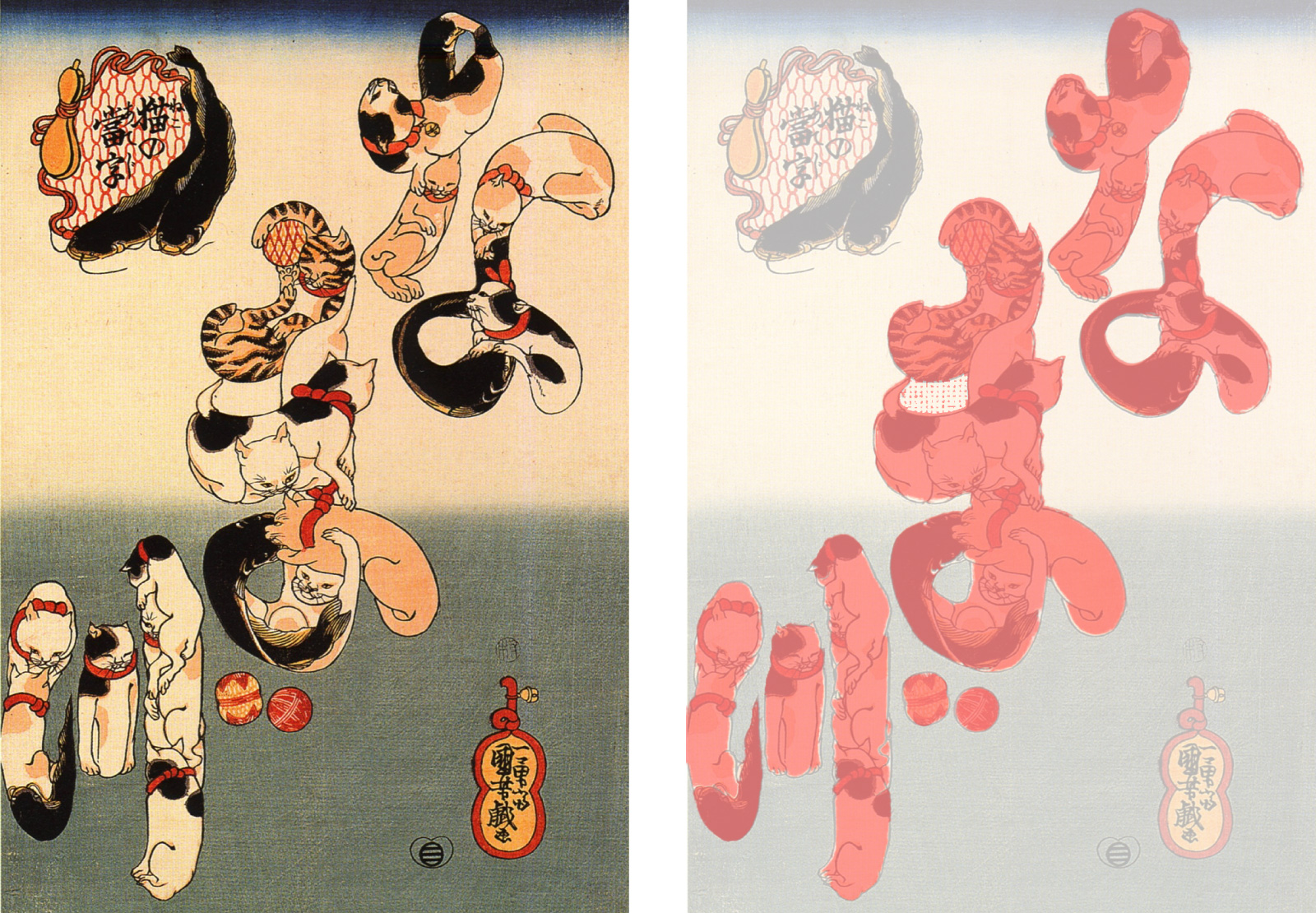
The more you look, the more you find yourself thinking: how did he even think of this? It’s a reminder of just how deep Edo’s creative energy ran.
This kind of word-play was never just a joke.
People in the Edo period moved between image and text far more fluidly than we tend to today. Calligraphy and painting were sister arts — both done with the same brush, growing from the same tradition. The idea of making a character out of a picture, or reading a word from an image, arose naturally from that cultural soil.
The pleasure of decoding a print. That, too, is part of what makes ukiyo-e so rich.
A Kimono Was a Business Card: What Patterns and Hairstyles Reveal
When you look at a bijin-ga — a ukiyo-e beauty print — where does your eye go first?
Probably the face. The expression.
But here’s what the connoisseurs of Edo were looking at just as carefully: the kimono pattern. The way the hair was arranged. Packed into those details was everything you’d need to know about who this person was.
Kimono Patterns: Rank and Occupation at a Glance
Edo society was governed by a strict hierarchy, and clothing was one of its clearest markers. Samurai and aristocrats could only wear certain colors and patterns. Commoners were sometimes prohibited from wearing bright dyes. Within those constraints, people competed fiercely — within the rules — to look as refined and stylish as possible.
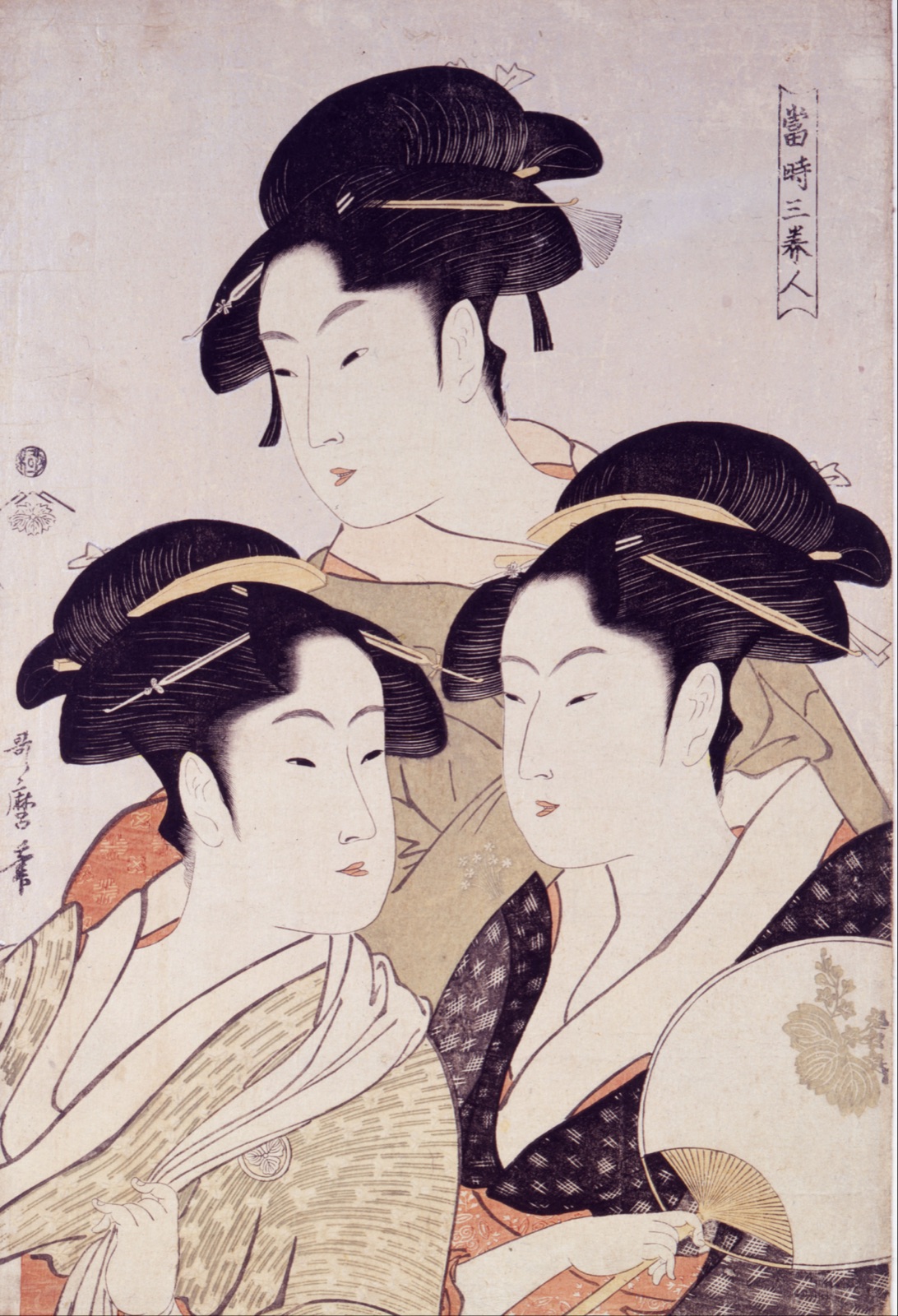
The kimono patterns in beauty prints are a direct record of those distinctions. An oiran — a high-ranking courtesan from the Yoshiwara — might wear elaborate embroidery and bold, oversized motifs, her clothing a deliberate proclamation: I am exceptional. A townsgirl or domestic servant, by contrast, tends to appear in quieter, smaller-scale patterns.
Plum, Chrysanthemum, Pine: The Symbols Continue
The symbolic vocabulary we met earlier applies directly to kimono patterns.
A plum motif suggests resilience and elegance. Chrysanthemums carry connotations of nobility and long life. Pine means prosperity. Once you have that vocabulary, the kimono in a beauty print suddenly becomes much more talkative. An artist wasn’t just dressing a figure — they were encoding her character, her aspirations, her story into the fabric she wore.
Hairstyles: A Woman’s Introduction
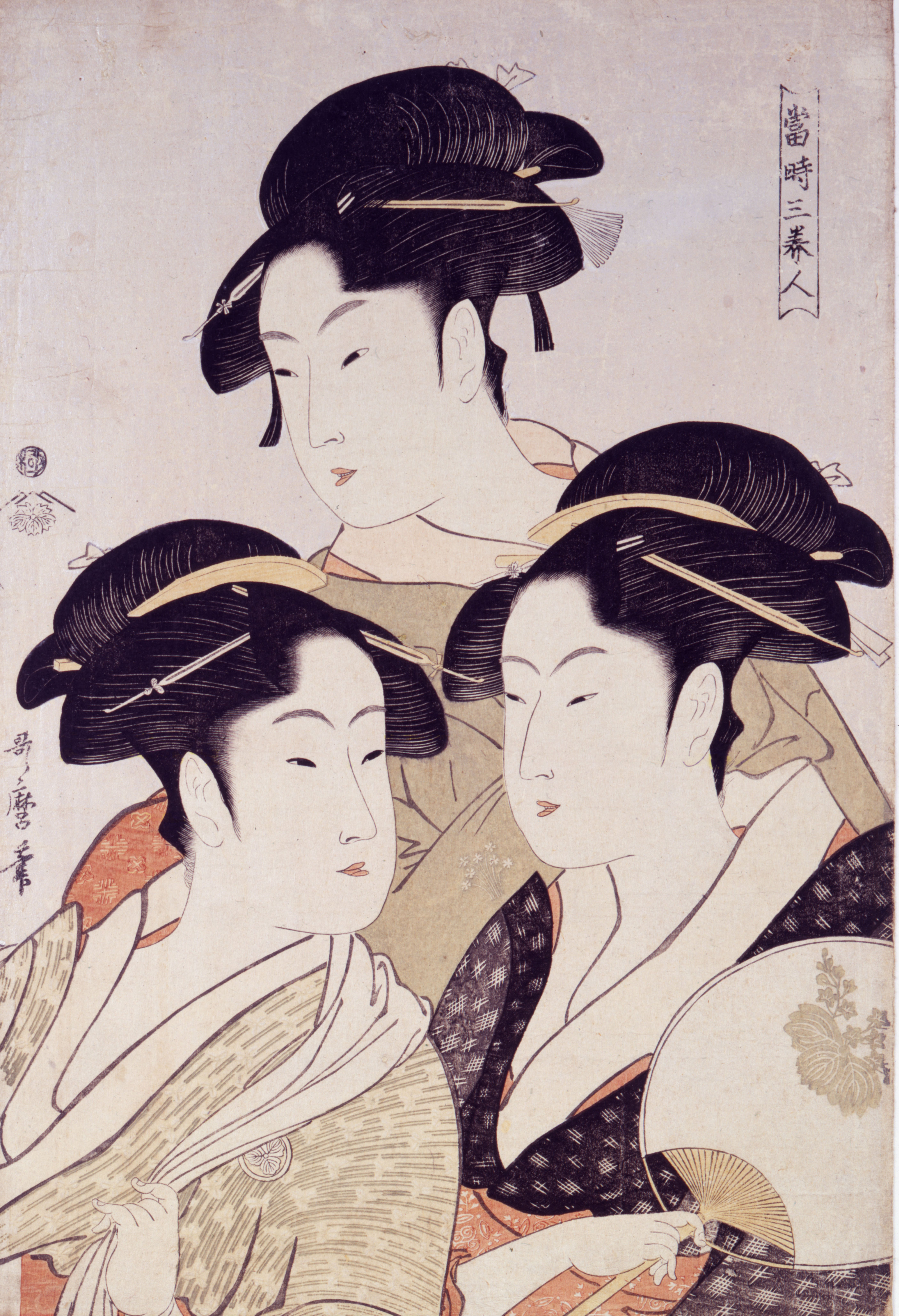
In Edo, a woman’s hairstyle told you a surprising amount about her. Married or unmarried? What was her profession? Where was she from? The distinctions were remarkably fine-grained.
In Utamaro’s beauty prints, each hairstyle is carefully differentiated. The shimada style worn by unmarried young women. The marumage of a married woman. The distinctive arrangements worn by geisha. With a little knowledge, you can read the figure in the print almost like a profile.
Once you know this, looking at a beauty print becomes a different experience entirely.
If It’s Banned, Just Use Cats: The Artists’ Defiant Wit
The Edo government periodically cracked down on popular culture.
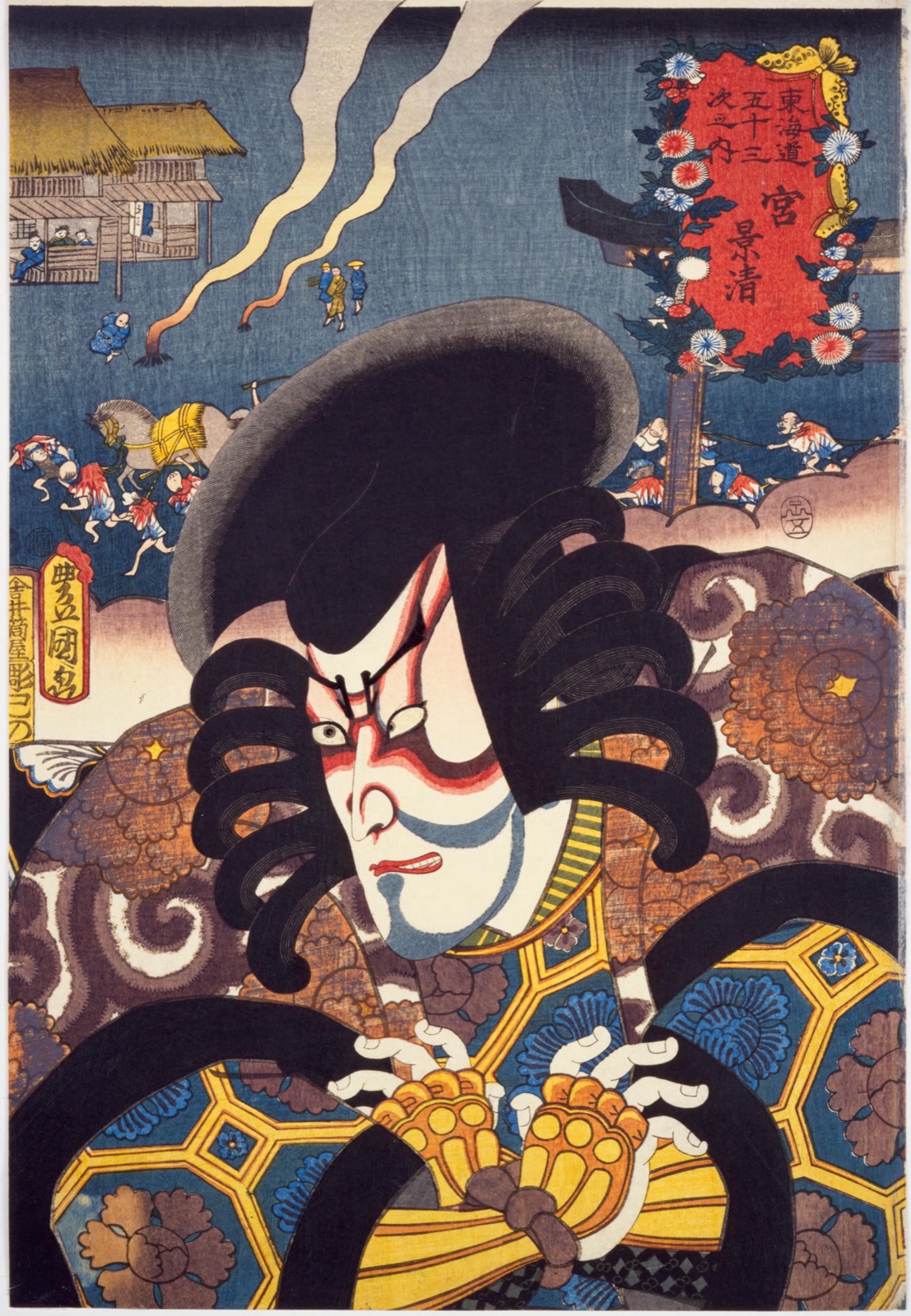
The most sweeping of these was the Tenpō Reforms of 1842 — a wave of moral and economic restrictions that hit ukiyo-e hard. Printing images of actors or courtesans was now prohibited. Two of the genre’s most beloved subjects were suddenly off-limits.
What did the artists do?
They kept going.
Utagawa Kuniyoshi began replacing the banned actors with cats. And fish. And gourds.
Cats posed in dramatic mie stances — the frozen, expressive moments that Kabuki actors held at climactic points in a performance. Fish delivering lines from the gidayū recitative style used in puppet theater. Gourds acting out famous scenes from the Kabuki stage. Absurd on the surface — but audiences immediately recognized them: that’s the pose from Act Three, that’s the move that belongs to such-and-such house.
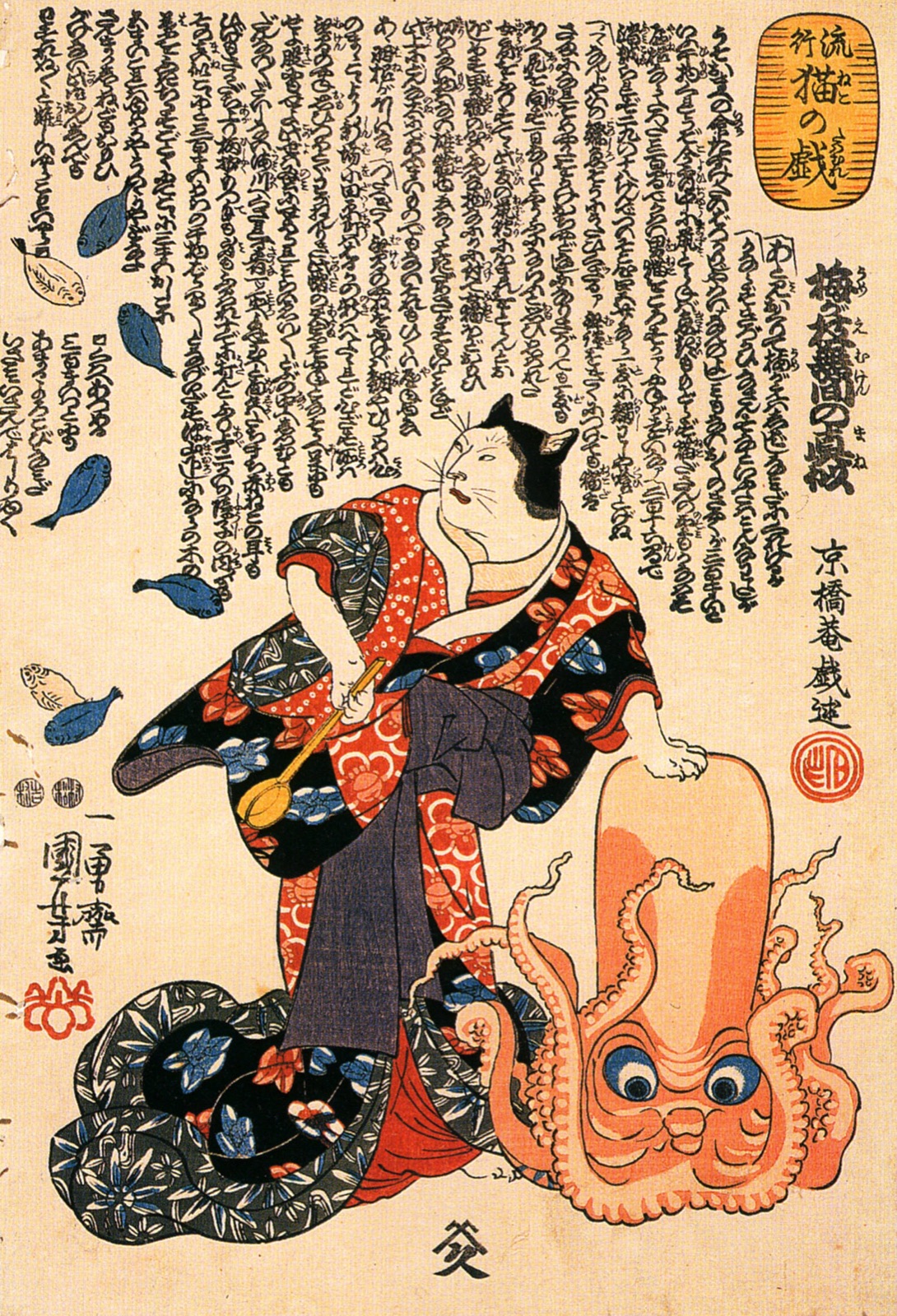
Kuniyoshi was sending coded messages to his fans using a cipher that government inspectors couldn’t crack. It was defiance, and it was humor, and it was the pride of a craftsman who refused to be told what he could and couldn’t make.
And it wasn’t only cats. In his Goldfish (Kingyo zukushi) series, Kuniyoshi gave the starring role to goldfish.
In Tama ya Tama ya, goldfish have dressed themselves as street vendors selling soap bubbles, strolling through Edo as if they belonged there. In Hyaku Mono Gatari, a cat peers into a goldfish bowl while the goldfish scatter in panic. If you’ve been reading along, you might catch it: the cats who spent this whole article performing kabuki have now turned around and started terrorizing the goldfish. There’s something quietly satisfying about that.
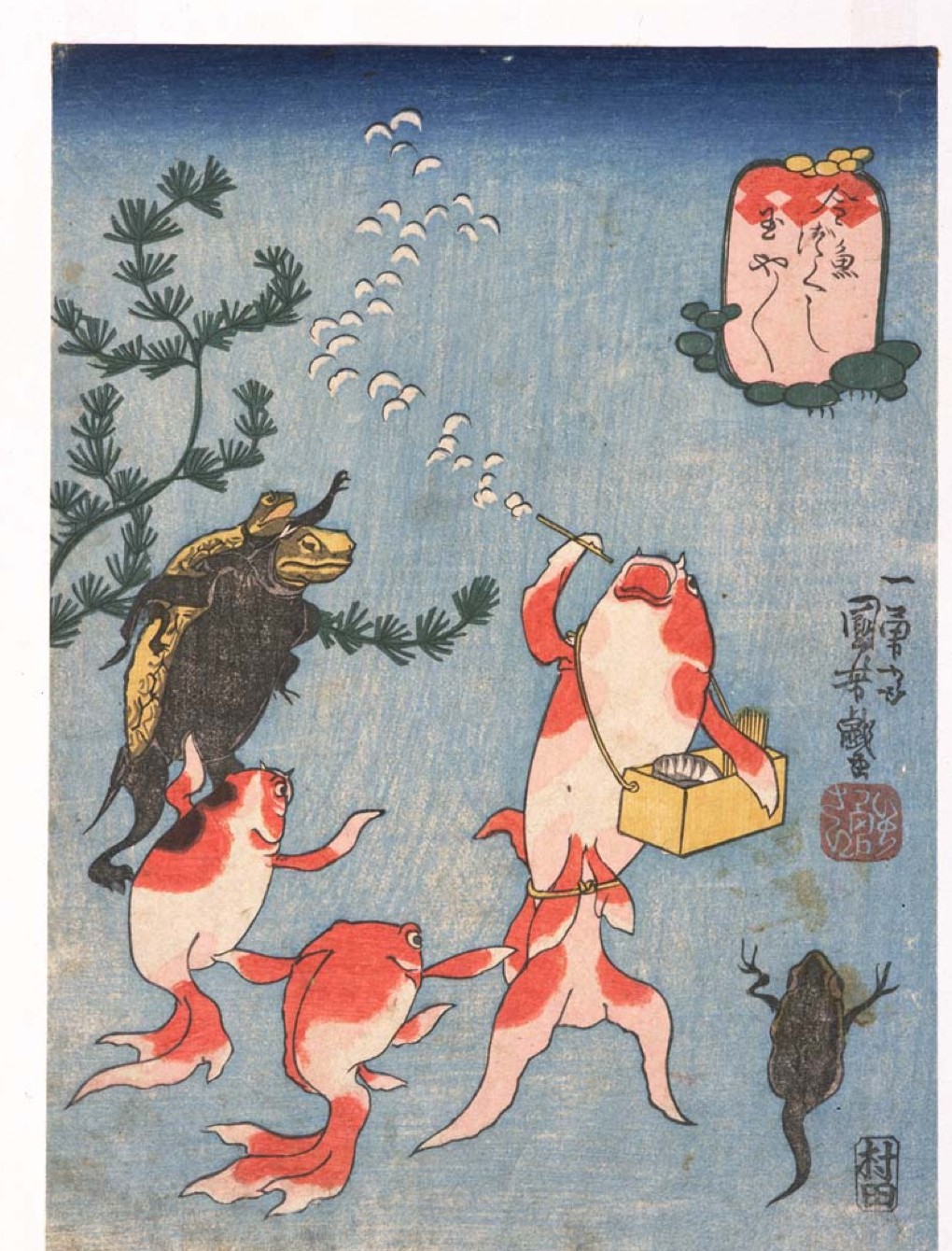
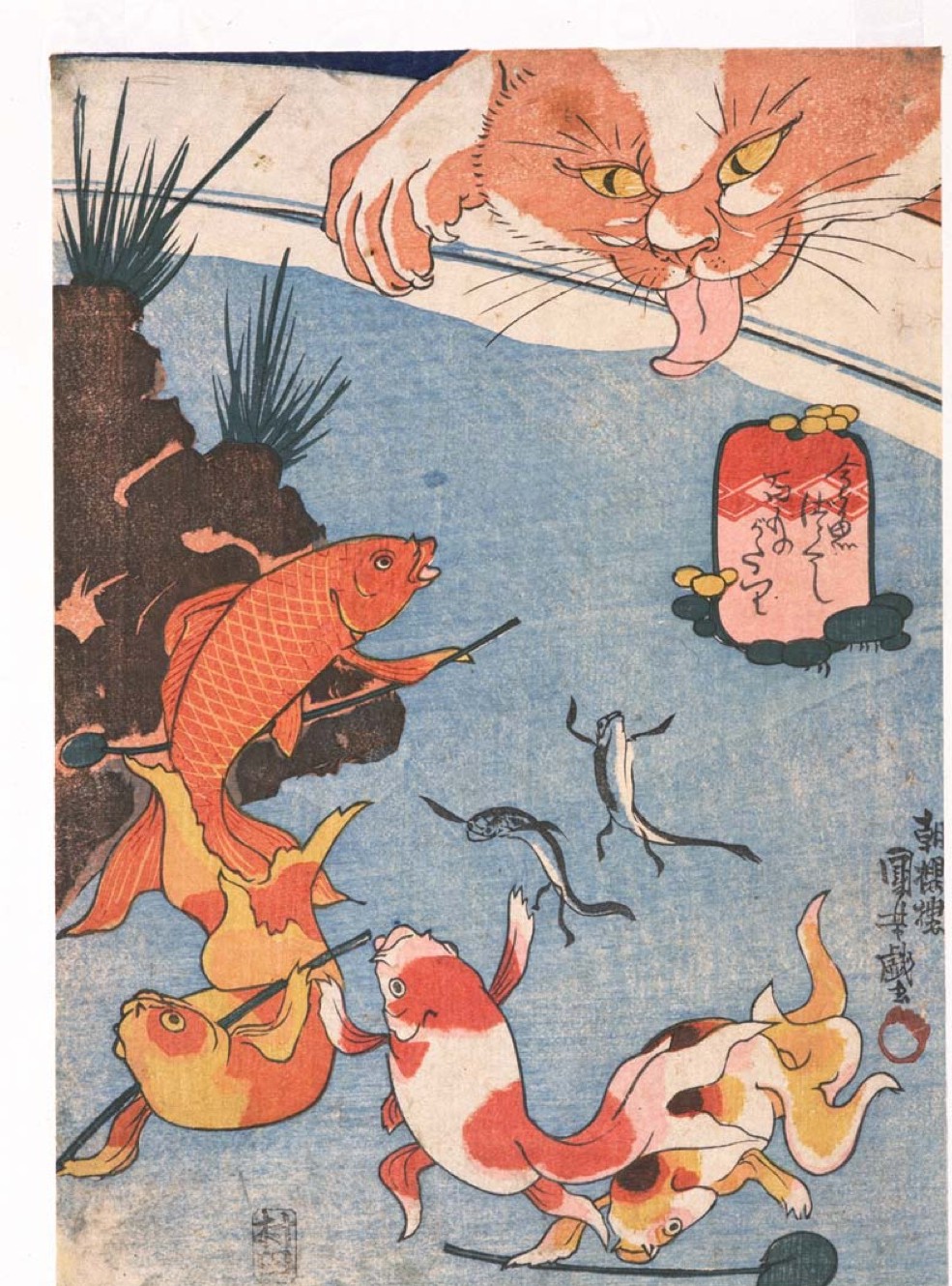
Not actors. Not people. Goldfish. For Kuniyoshi, animals weren’t just a subject — they were a way through.
This tradition of the hidden image runs through all of ukiyo-e.
A landscape that appears perfectly innocent but carries a specific political barb. A beauty print that functions, on a second reading, as an insult aimed at someone in power. Prints like these hang on museum walls today, looking for all the world like straightforward art.
So the next time you stand in front of a ukiyo-e print, try holding one question in mind: What is this artist laughing at?
How to Look: A Practical Guide for the Museum
A few suggestions for your next museum visit.
Start with the kimono pattern and any props the figure is holding. If you spot flowers or animals, run through the symbols we met earlier. Then shift to the background — look at what’s been placed there, and ask whether it’s telling you something about the scene. Unexpected objects often are.
Most importantly: trust the sense that something is slightly off, or strangely familiar, or more elaborate than it needs to be. That feeling of why did they use that? is almost always the entrance to a mitate, a hanji-e, or a joke that’s been waiting two centuries for someone to get it.
It doesn’t matter if you can’t quite decode it yet. The feeling that something is here — that instinct alone is the beginning of a real conversation with these prints.
A Final Note
Ukiyo-e was the popular culture of Edo — the prints people bought for the price of a bowl of noodles, read on the way home, and pinned to their walls.
But it was also an art that held an extraordinary amount: symbols, allusions, riddles, coded resistance, beauty layered over irony layered over wit. The messages pressed into these prints are still arriving, two centuries later.
The next time you find yourself in front of one, try slowing down just a little.
Not just looking. Reading.
I think you’ll find ukiyo-e pulls you in a lot closer than you expected.