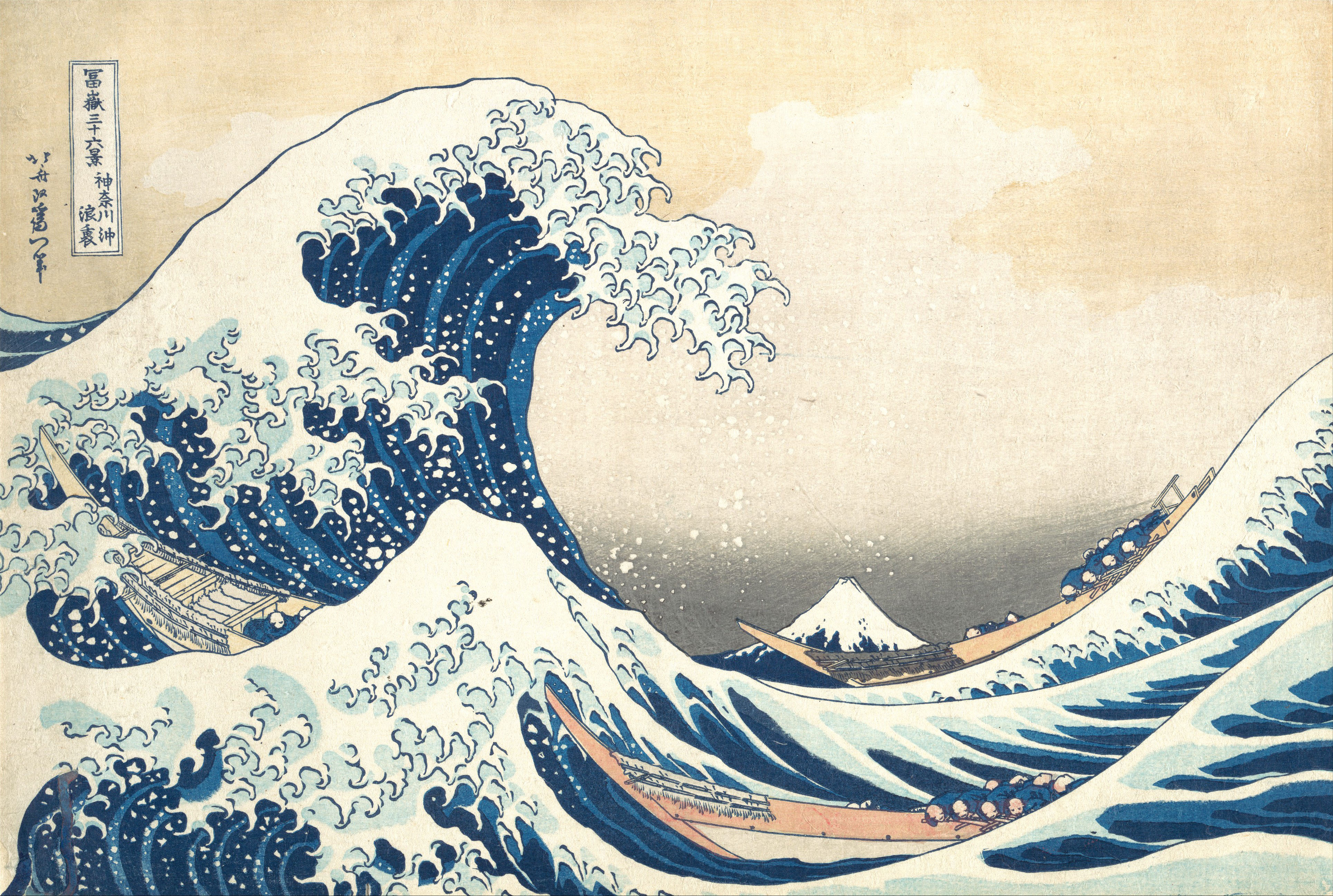
Most people who know The Great Wave don’t know that it was the first print in a series of forty-six.
Why was it chosen to open the series? Part of the answer lies in a color. Around 1831, when the series launched, a vivid imported pigment called bero-ai — Prussian blue, brought to Japan through Dutch trade — was sweeping through Edo. Its intensity and clarity far exceeded anything available in traditional Japanese pigments, and artists and craftspeople took to it immediately. Hokusai used this new blue to produce the color of that wave. Blue that stops the eye in an instant — The Great Wave was the perfect front cover for the series, designed to capture attention from the first moment.
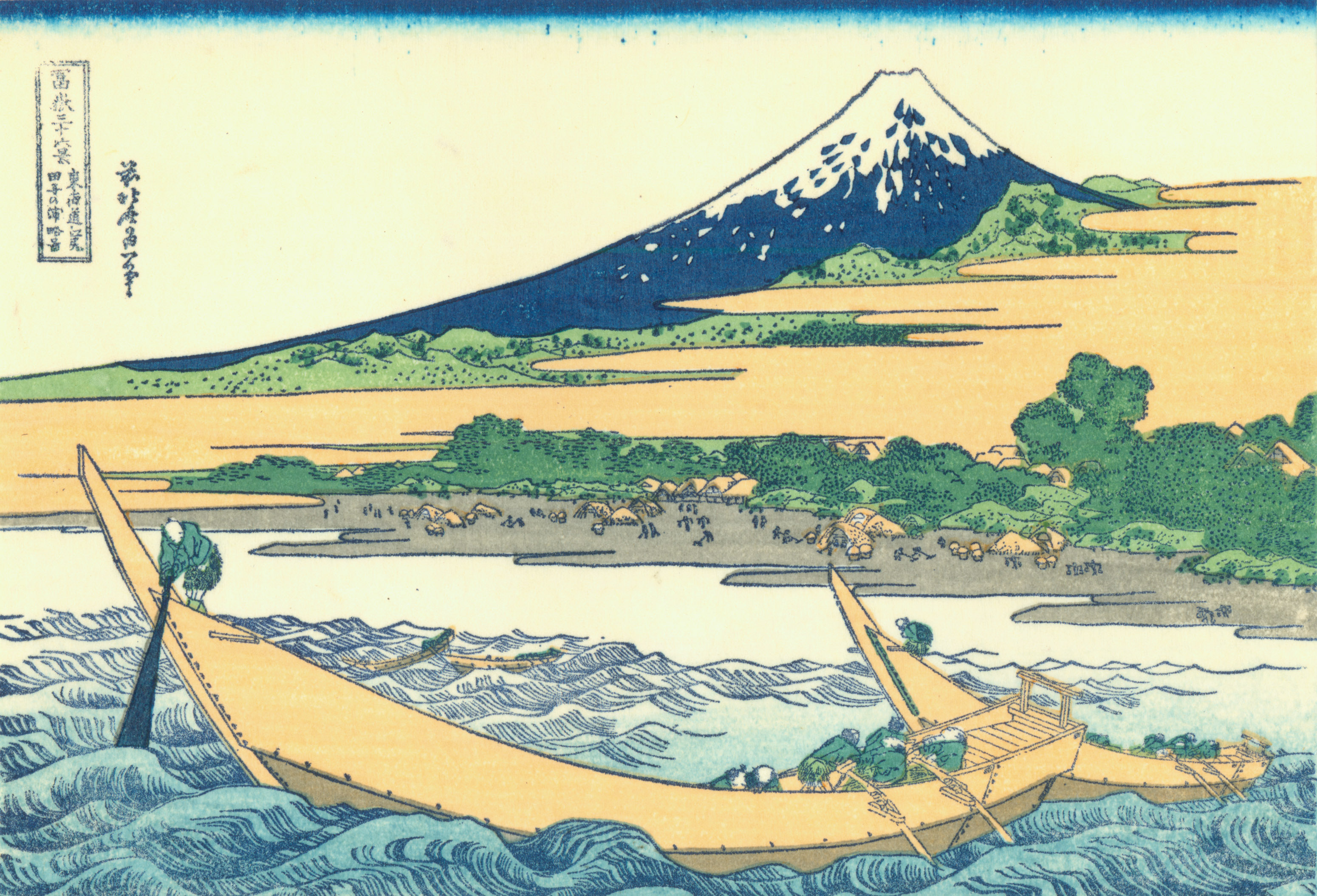
Thirty-Six Views of Mount Fuji is Hokusai’s signature series: a collection of prints depicting the mountain from different locations, seasons, and conditions, published from 1831 onward. Today I’d like to walk through it, focusing on the prints that stay with you.
1. Why “Thirty-Six” Views Has Forty-Six Prints
A quick overview before we look at individual works.
The title says thirty-six views. The actual series contains forty-six prints. The first thirty-six were so popular that Hokusai added ten more — and the title stayed as it was.
The two groups are known as Omote-Fuji (“Front Fuji”) and Ura-Fuji (“Back Fuji”). The names come from the orientation of the mountain: the face of Fuji that Edo residents knew and recognized is the “front”; views from the other side are the “back.”
Omote-Fuji (the first 36 prints): Multi-color printing in bold blue and red. Strong compositions, strong colors.
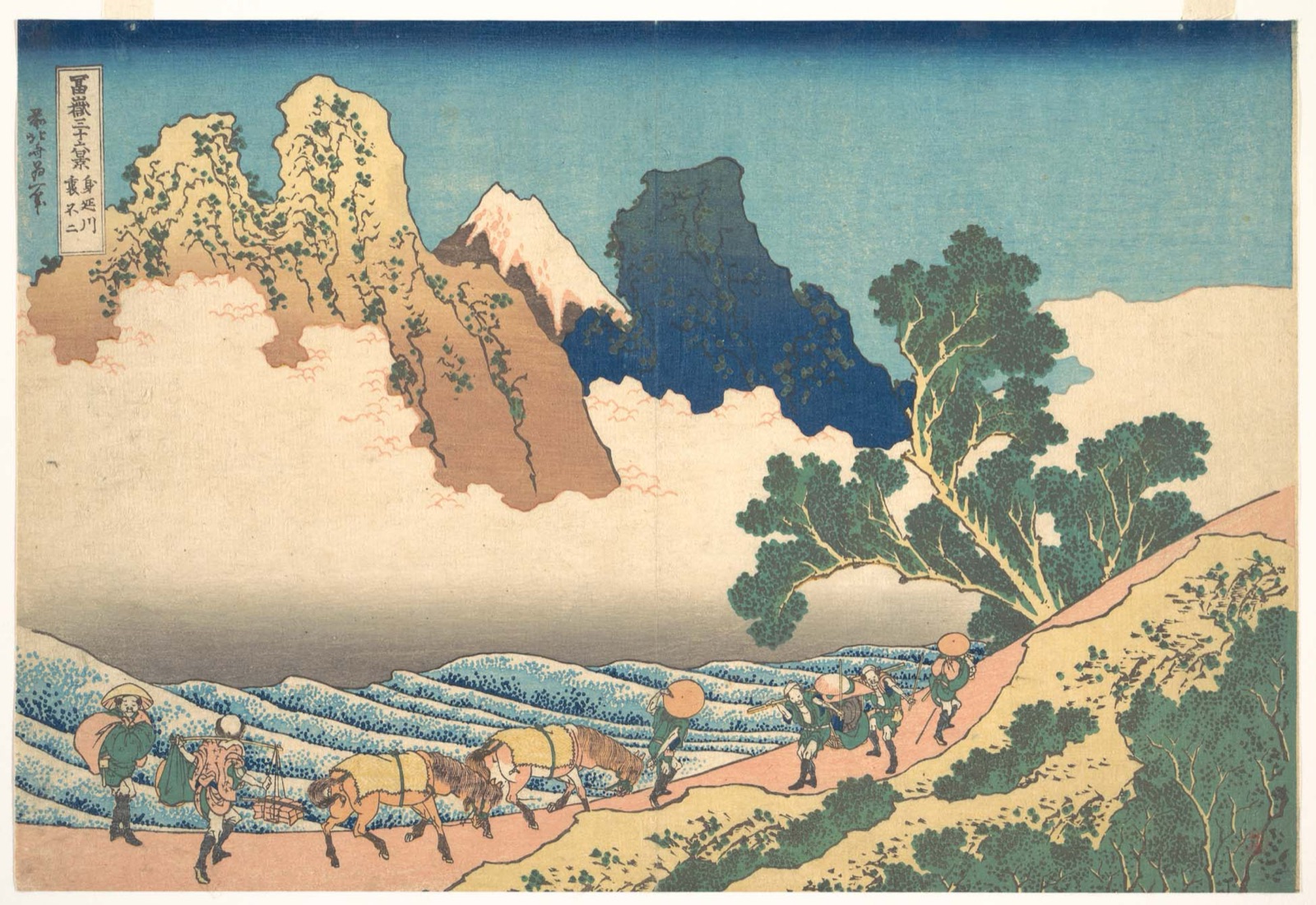
Ura-Fuji (the additional 10 prints): Predominantly quieter, blue-toned prints. A more subdued mood.
2. Ten Prints Worth Knowing
A selection from the series — the ones I keep coming back to.
The Great Wave off Kanagawa — Motion and stillness The face of the series. Beneath a wave about to break, Mount Fuji sits small and still in the far distance. The contrast between the ocean’s violence and the mountain’s composure is as stark as it gets — and it holds.
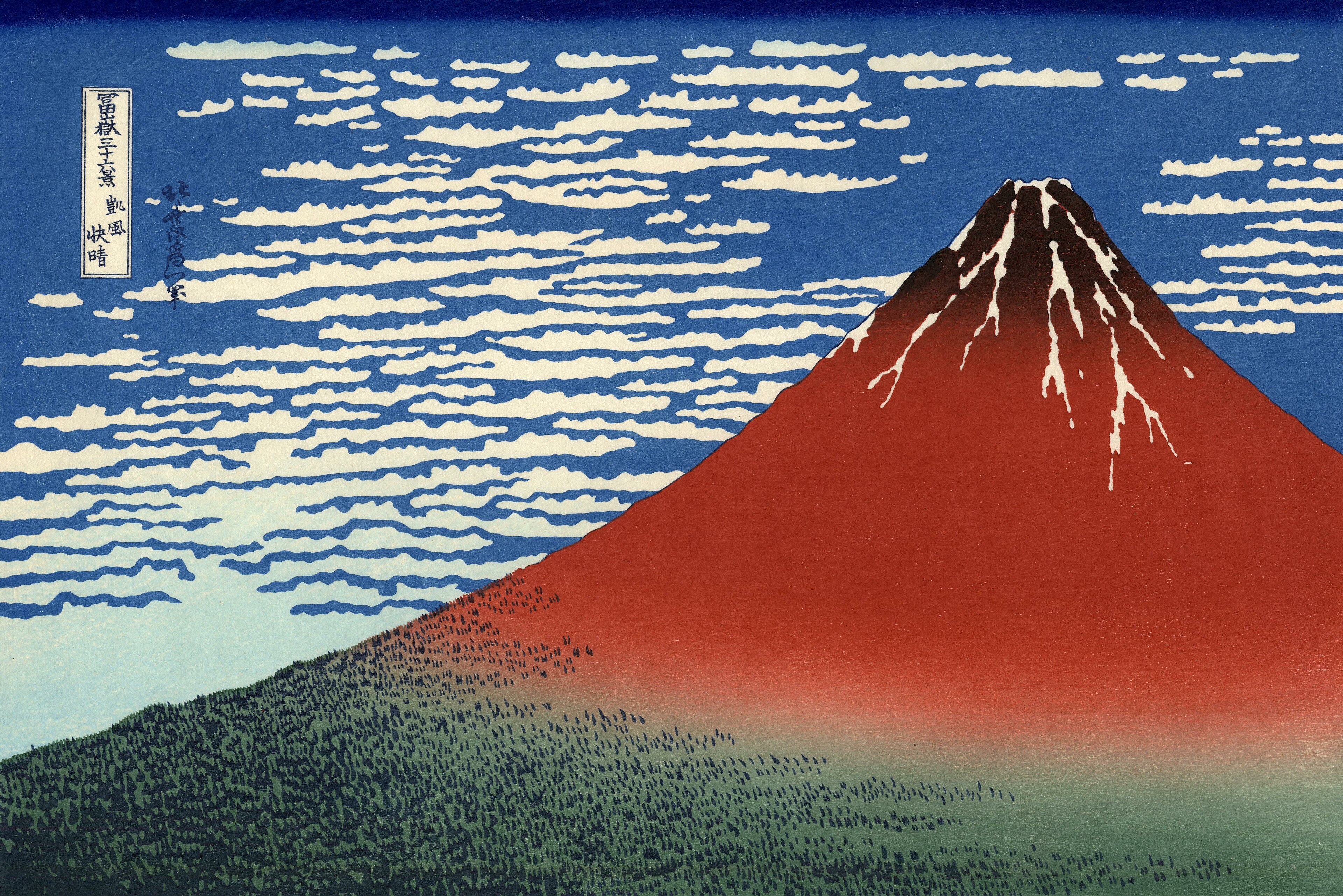
Gaifū Kaisei (“Fine Wind, Clear Morning”) — Red Fuji Fuji at summer dawn, the mountain flushed red in the early light. Where The Great Wave is turbulent, this print is pure stillness. The mountain is simply there. That’s enough.
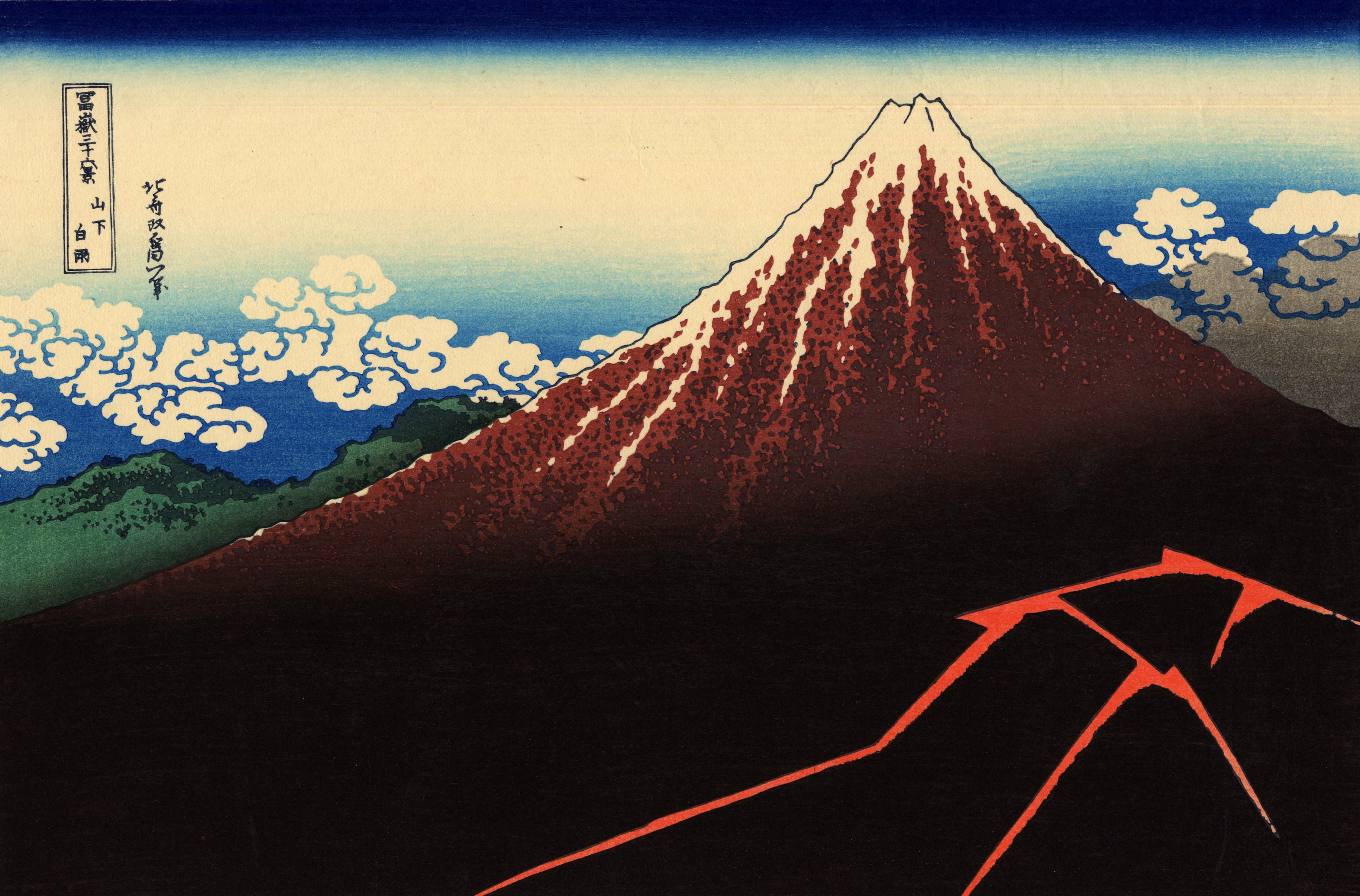
Sanka Hakuu (“Thunderstorm Beneath the Summit”) — Black Fuji The peak in sunshine, the lower slopes in a thunderstorm. Two kinds of weather in one frame — a showcase of Hokusai’s compositional intelligence.
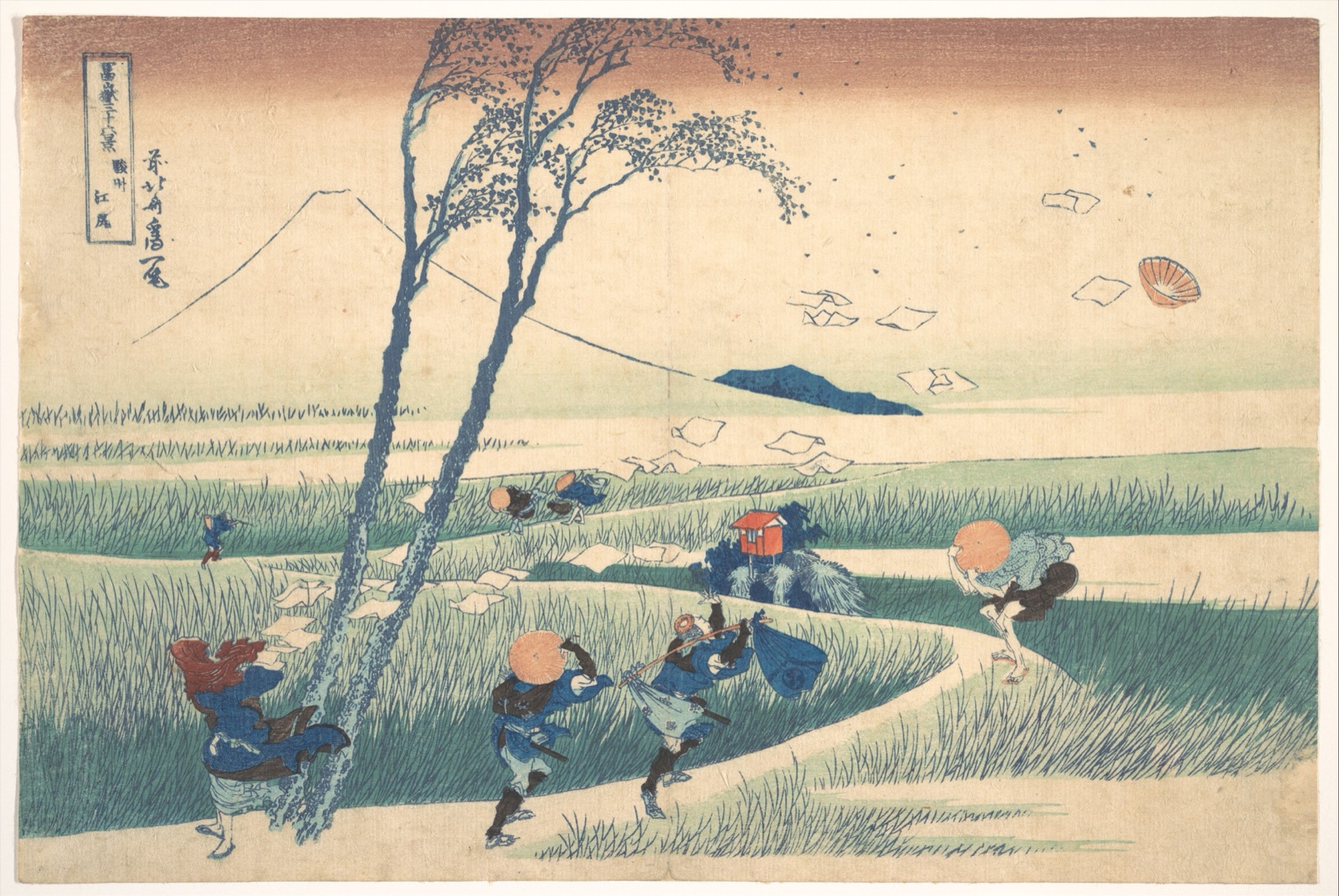
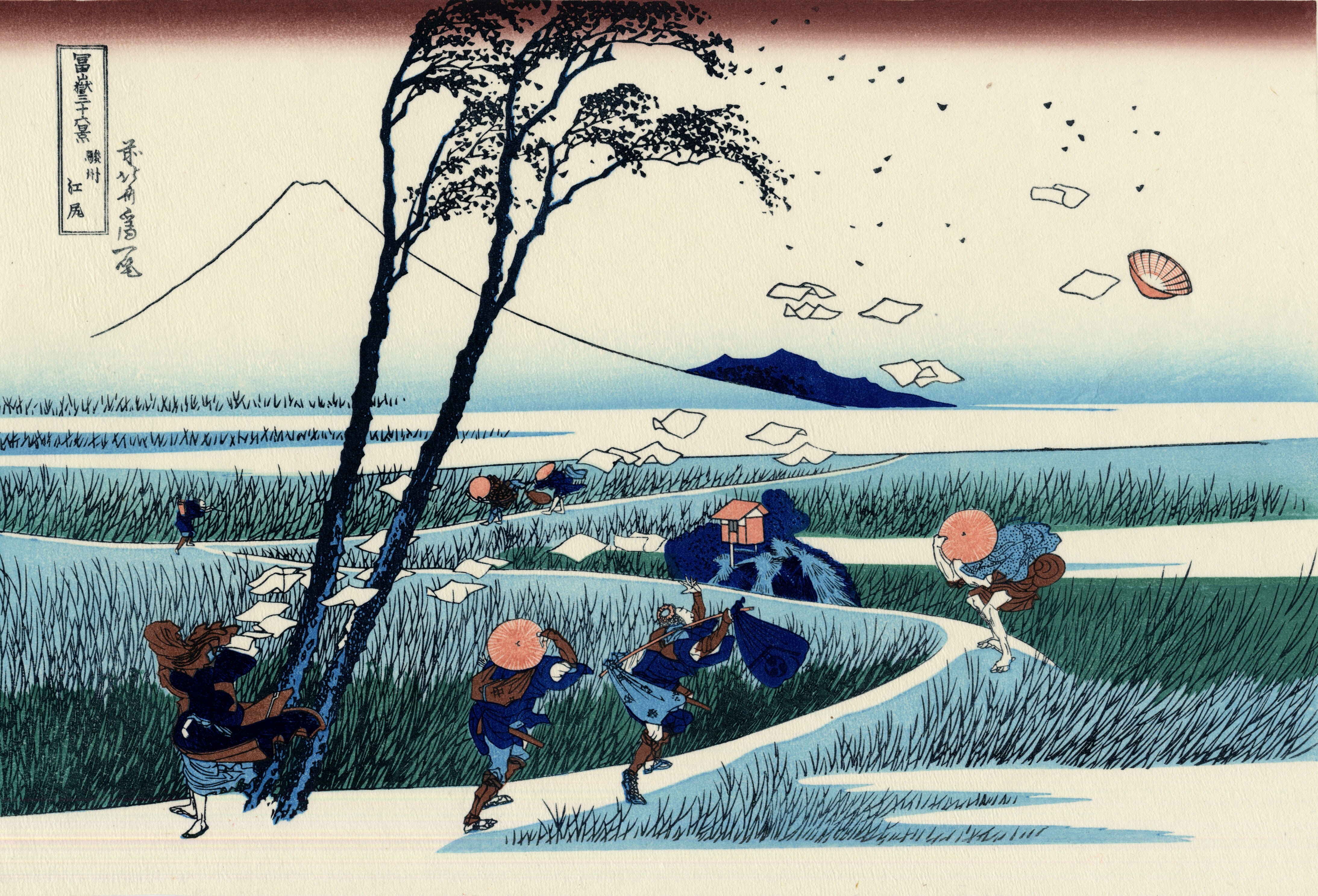
People in a storm Hats and parcels flying through the air, travelers chasing after them in the wind — a scene of comic chaos, with Fuji anchoring the background, utterly unmoved.
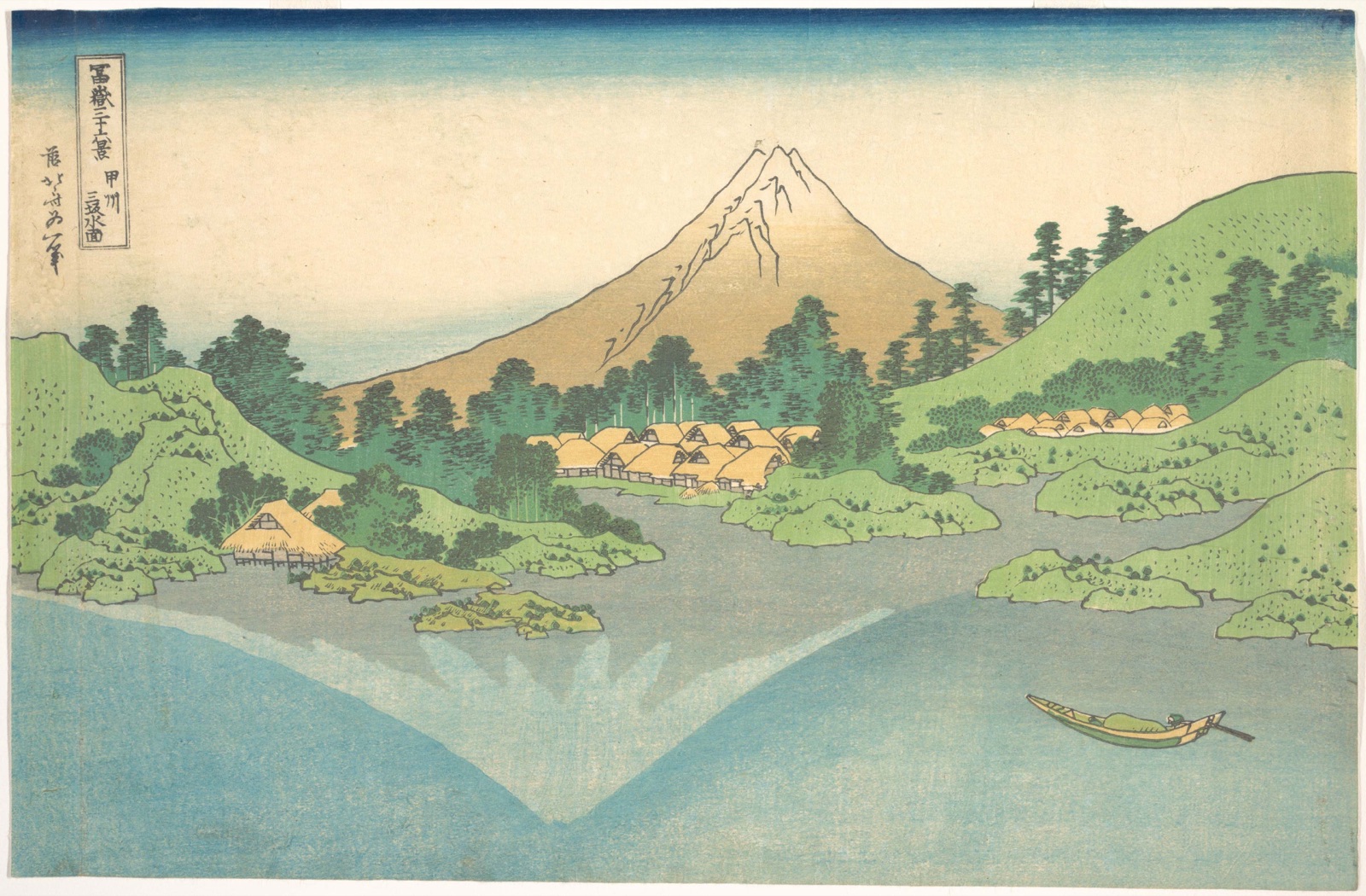
Kōshū Misaka Suimen (“Reflection in Lake at Misaka”) — Fuji on the water Seen from Misaka Pass, Fuji rests beside its own reflection on a still lake. Curiously, the reflected peak wears snow the real mountain has shed — a quiet bit of Hokusai mischief. The balance of mountain and mirror is serene.
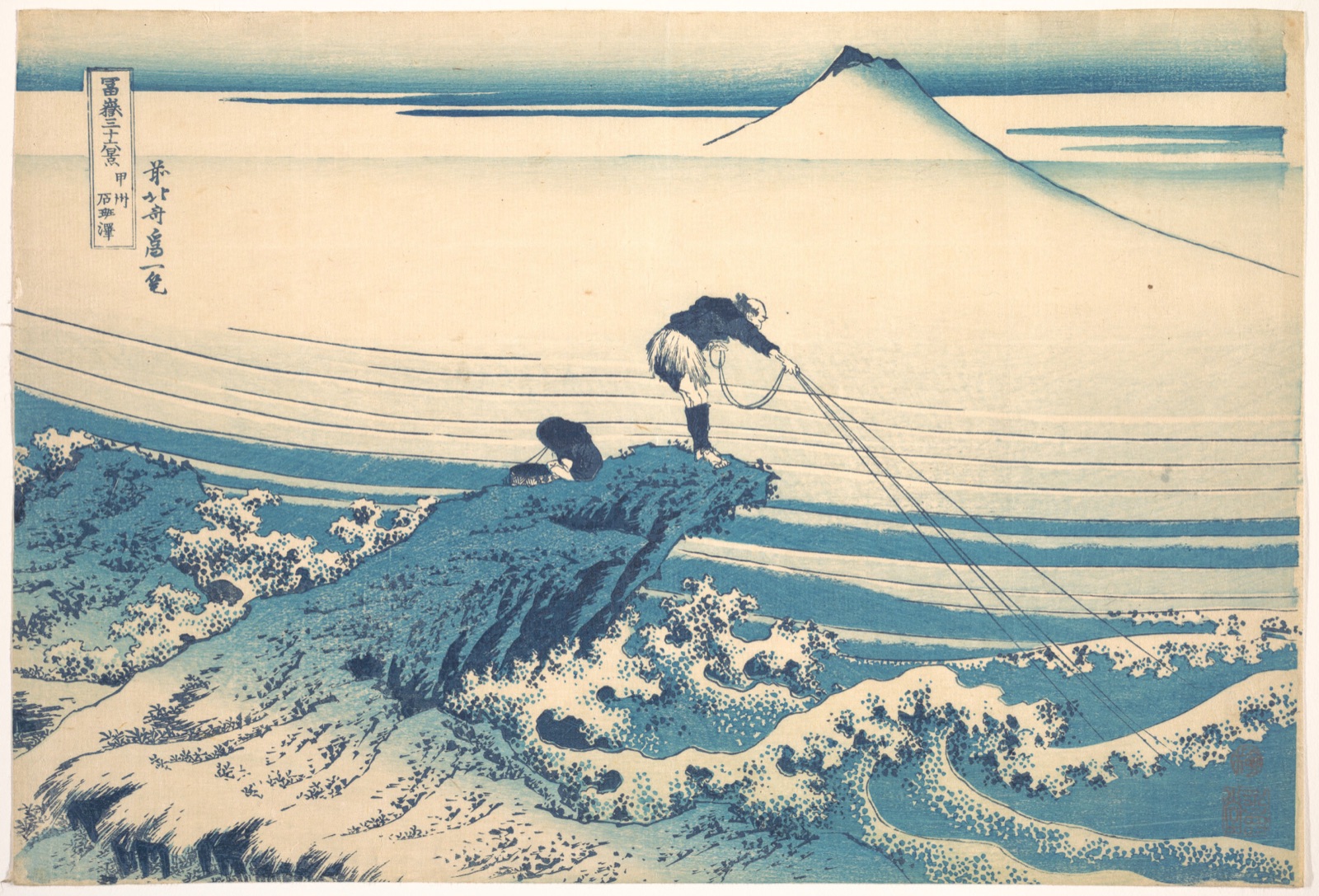
Kōshū Kajikazawa (“Kajikazawa in Kai Province”) — A fisherman and the tide A fisherman casts his net from a rocky spur, his lines echoing the slope of Fuji behind him. The labor of daily life in the foreground, the mountain in the distance — a gentle comment on the relationship between human activity and the natural world.
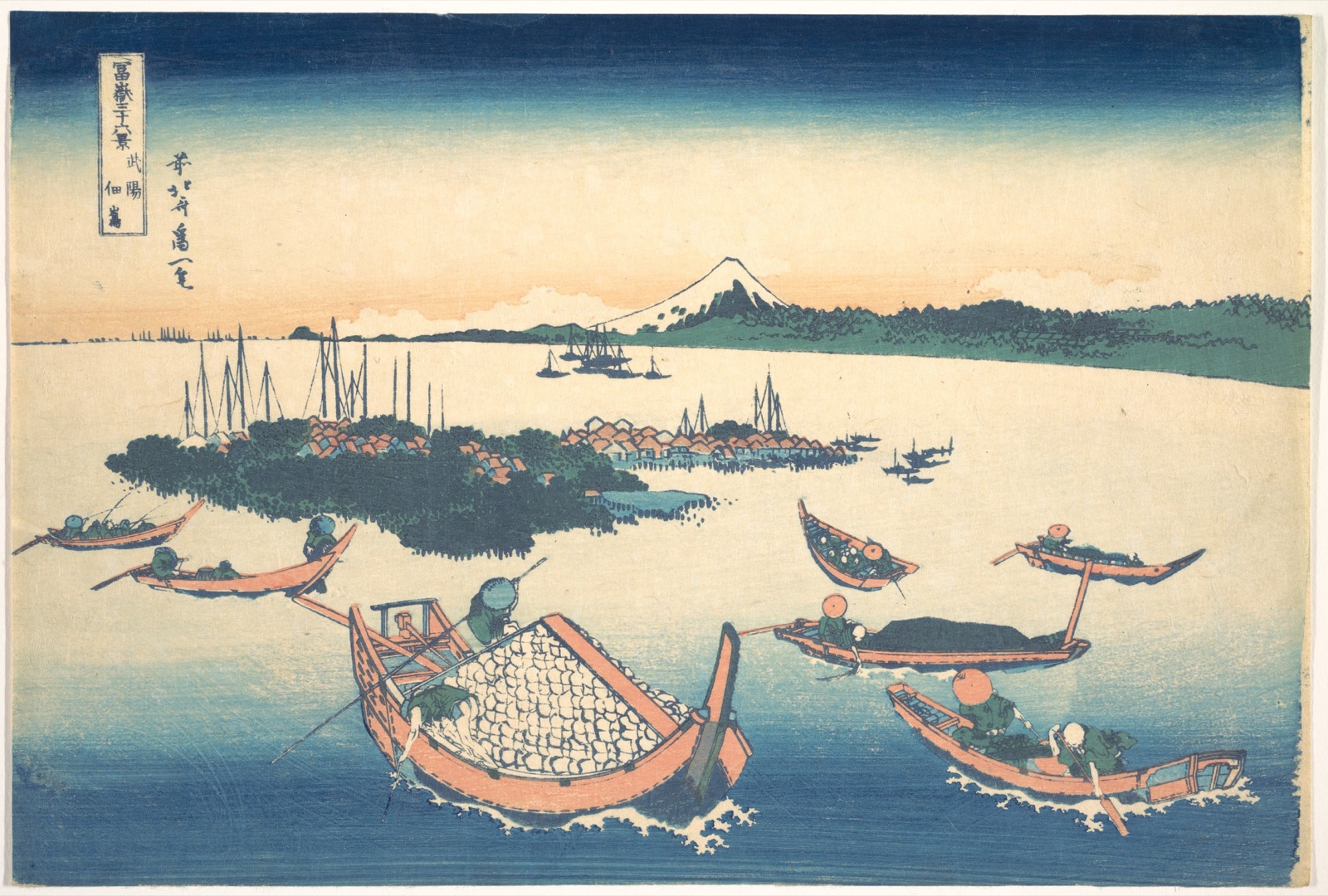
Buyō Tsukudajima (“Tsukuda Island in Edo”) — Fuji over the harbor Boats and rooftops crowd the little island of Tsukuda, with a faint Fuji barely visible through the haze beyond. The mountain dissolved into everyday life.
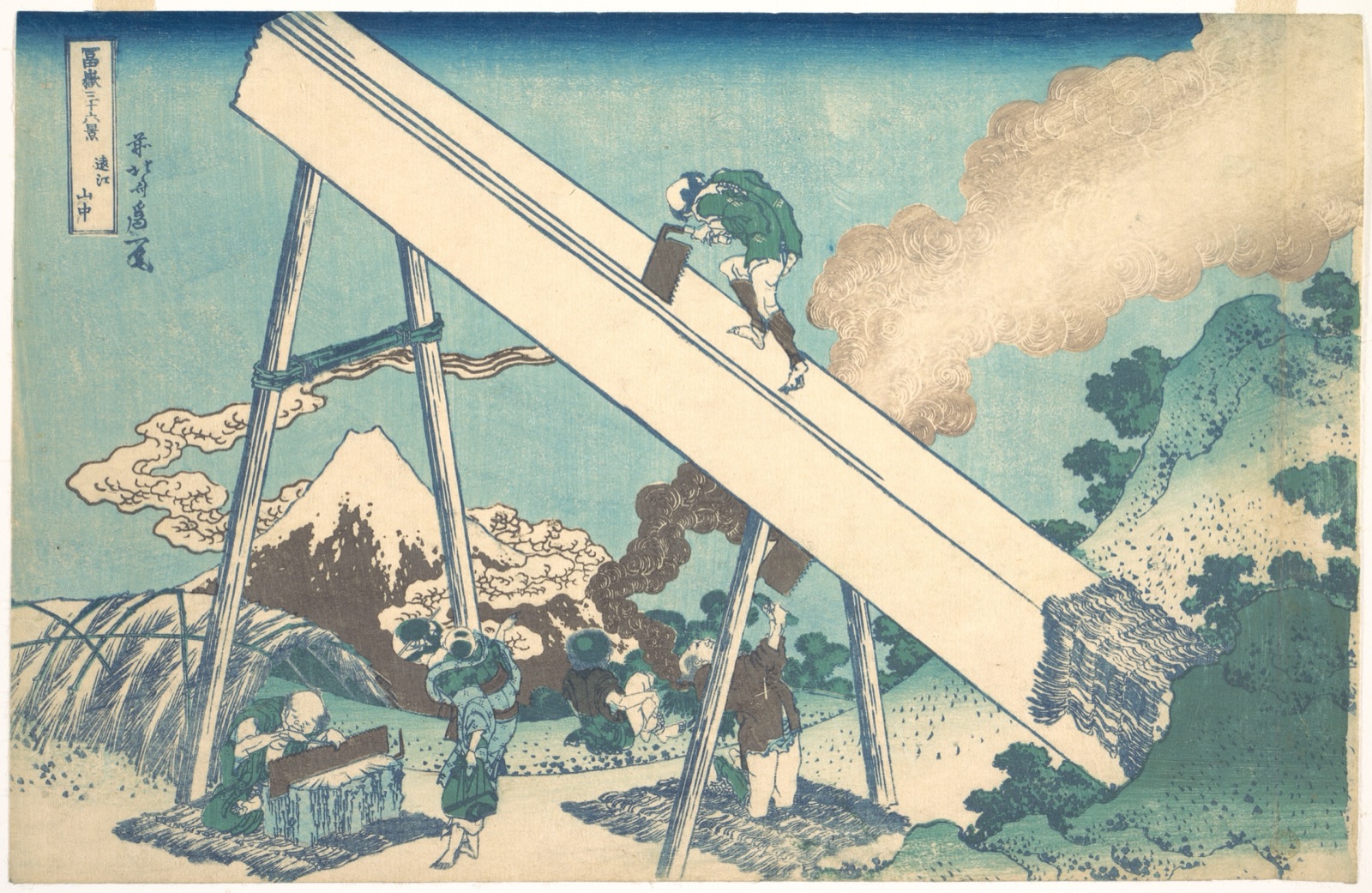
Tōtōmi Sanchū (“In the Mountains of Tōtōmi”) — The woodcutters Craftsmen saw an enormous timber that towers many times their own height. The closeness and scale of the wood against the smallness and distance of Fuji give you a sense of nature’s proportions.
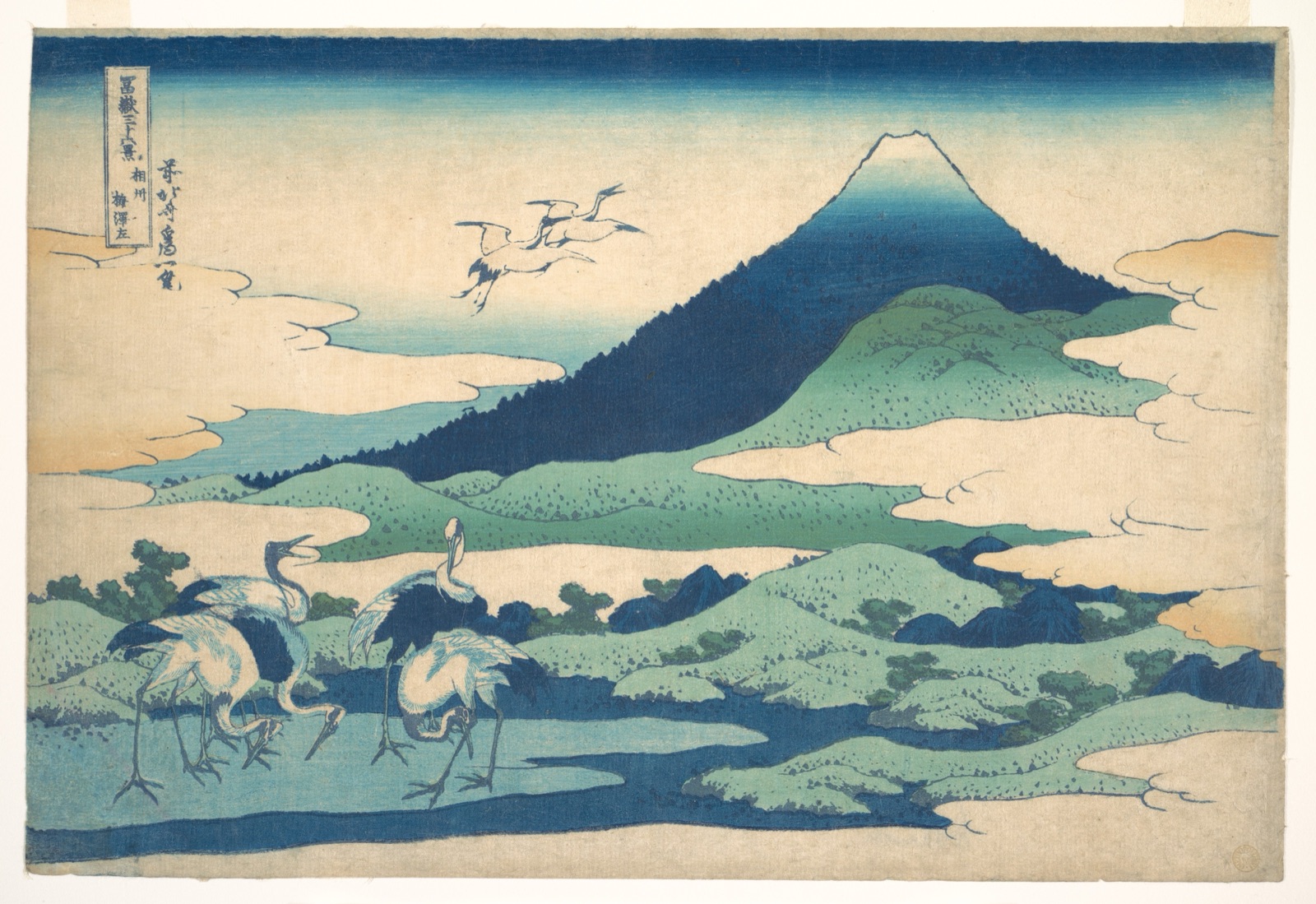
Sōshū Umezawa (“Umezawa in Sagami Province”) — Cranes at dawn Red-crowned cranes gather by a stream in the pink hush before daybreak, a few rising toward the mountain. Fuji stands in the stillness — a print from which all sound has been removed.
Shojin Tozan (from Ura-Fuji) — Fuji from the inside Climbers ascending the mountain, seen from within — toward the dark opening of the crater. An unusually rare perspective: looking into the mountain from the inside. There’s nothing else quite like it in the series.
3. The Game of Finding Fuji
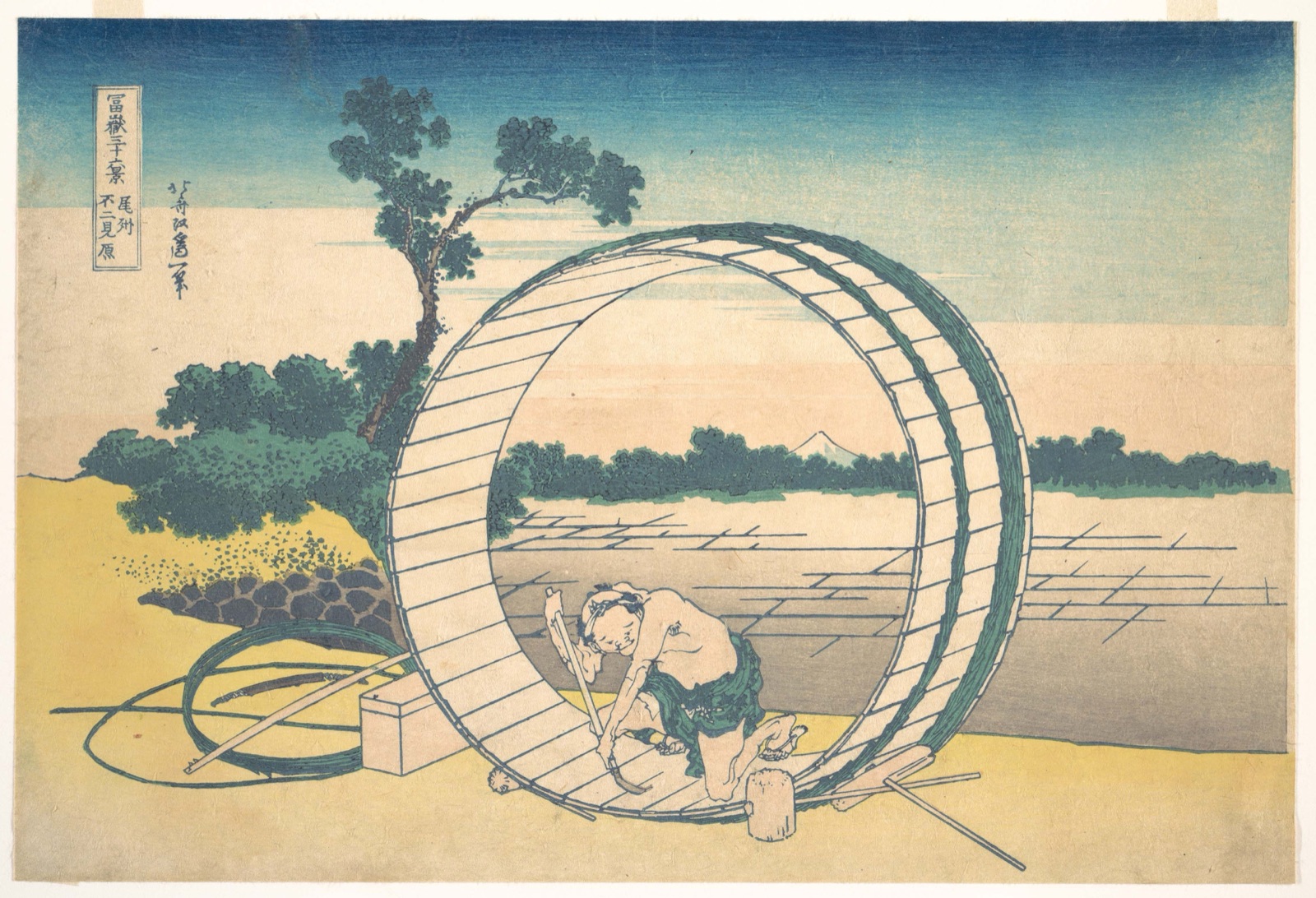
Some prints in this series show almost no Fuji at all.
A small shape in the corner of the frame, a faint outline through the haze — there are several prints where the mountain barely appears. Looking for it is its own game, and one Hokusai may have intended as a quiet joke.
Try going through all forty-six with that in mind. The series takes on an extra dimension.
4. Omote-Fuji and Ura-Fuji: What’s the Difference?
Omote-Fuji is Hokusai showing you the Fuji he wanted to show you: bold, vivid, compositionally daring. The Great Wave, Red Fuji, Black Fuji — all here.
Ura-Fuji is quieter and more blue-toned — the feeling of encountering Fuji unexpectedly on a journey rather than standing before it. Less showy than Omote-Fuji, but worth the patience.
Among collectors, the condition of the printing blocks and the quality of individual impressions are also points of interest across the two groups.
5. How to Experience the Series
In fact, seeing all forty-six prints at once is a rare opportunity. The series is spread across collections around the world, and only a portion tends to be on view at any given time.
The most reliable place to start is online. The Metropolitan Museum of Art (New York) makes its holdings from Thirty-Six Views of Mount Fuji freely available in high resolution through their digital collection. The detail you can examine on screen is remarkable.
For the real thing, check exhibition schedules first. The Sumida Hokusai Museum (Tokyo) and the Ōta Memorial Museum of Art (Tokyo) both show original prints from the series, but only when their exhibition programming calls for it. Always check what’s on before you visit.
A Final Thought
Going through all forty-six prints, you sense something — a quiet, persistent compulsion to face the same mountain again and again, from every possible angle and in every possible light.
Hokusai changed the season, changed the weather, changed the vantage point, placed different human lives in the foreground — and kept returning. And still, by his own account, felt he hadn’t finished.
You can look at any single print and find something worth holding. Or you can travel through all forty-six the way you’d travel a road — slowly, in order, watching the mountain change. Either way, the series meets you where you are.


References
- The Metropolitan Museum of Art, Thirty-six Views of Mount Fuji digital collection — metmuseum.org
- Sumida Hokusai Museum — hokusai-museum.jp
- Henry D. Smith II, Hokusai: One Hundred Views of Mt. Fuji, Braziller, 1988
- Roger Keyes, Hokusai, Taschen, 2014
Image Credit
- Cover image: Katsushika Hokusai, Sanka Hakuu (Thunderstorm beneath the Summit / Black Fuji), from Thirty-Six Views of Mount Fuji, c. 1831 — Public domain via Wikimedia Commons
- Section 2: Katsushika Hokusai, Ejiri in Suruga Province (Sunshū Ejiri), from Thirty-Six Views of Mount Fuji, c. 1831 — Public domain via The Metropolitan Museum of Art